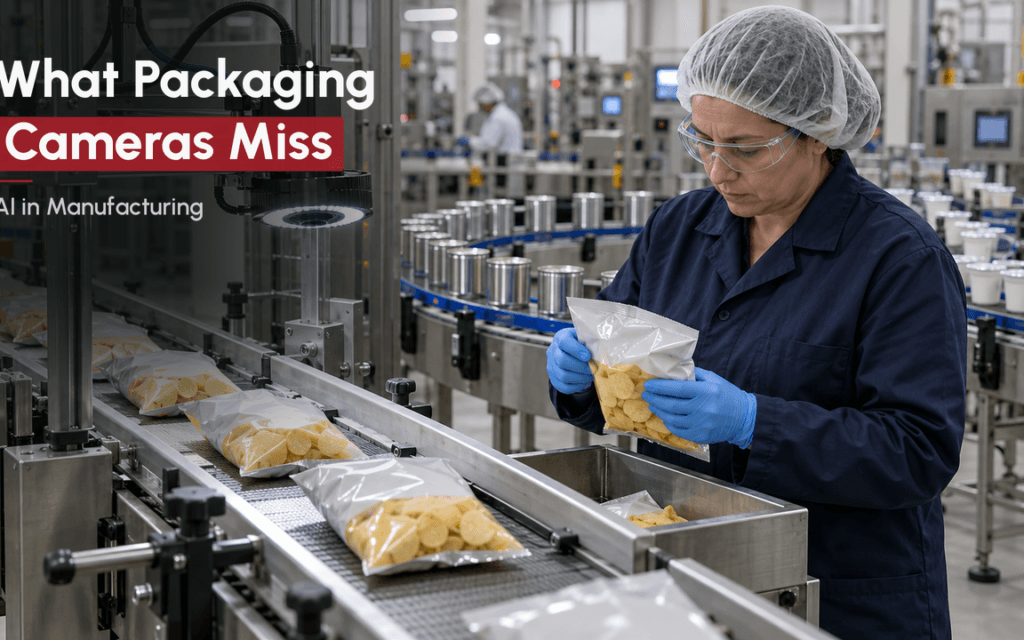
Packaging defect detection AI uses cameras and image analysis to flag visible problems such as wrinkled snack-bag seals, misaligned dairy-cup lids, dented cans and incorrect date codes. It cannot reliably prove the absence of microleaks or hidden double-seam defects. Canadian plants need matched sensors, independent integrity tests and line-specific validation before relying on it.
At a composite Ontario co-packer, the QA manager has just watched a convincing packaging-inspection demonstration. A camera finds a wrinkled snack-bag seal, a shifted dairy-cup lid and a dented can. The proposal is to expand inspection across all three lines and reduce manual checks. But a production system must find defective packages, not merely defective-looking demonstration samples.
That distinction changes the buying decision. On these lines, some failures leave visible marks and others leave an apparently normal pack. The manager must decide what each station can detect, what needs an independent test and what false rejects will cost.
A perfect demonstration is not a validated inspection system
The first concern is whether the impressive samples resemble ordinary shifts. In a 2021 industrial study of thermoformed food packaging, researchers reported 0.06% false positives and no false negatives during a 150-minute normal-production test, versus 0.30% false positives and 0.07% false negatives during a 105-minute run with machine-related sealing problems. These classify visible defects, not leaks, and are measured against total production.
The co-packer cannot copy those rates into its business case. It must test through stable running, faults, changeovers and reject actuation. A good image classification does not show that the PLC will remove the right package, or that a fault too small to image will be found.
 Reader offer · ends November 11Where is the hidden cost in your factory?Watch it with 3 months of Premier free →
Packaging defect detection AI can judge only what the camera can see
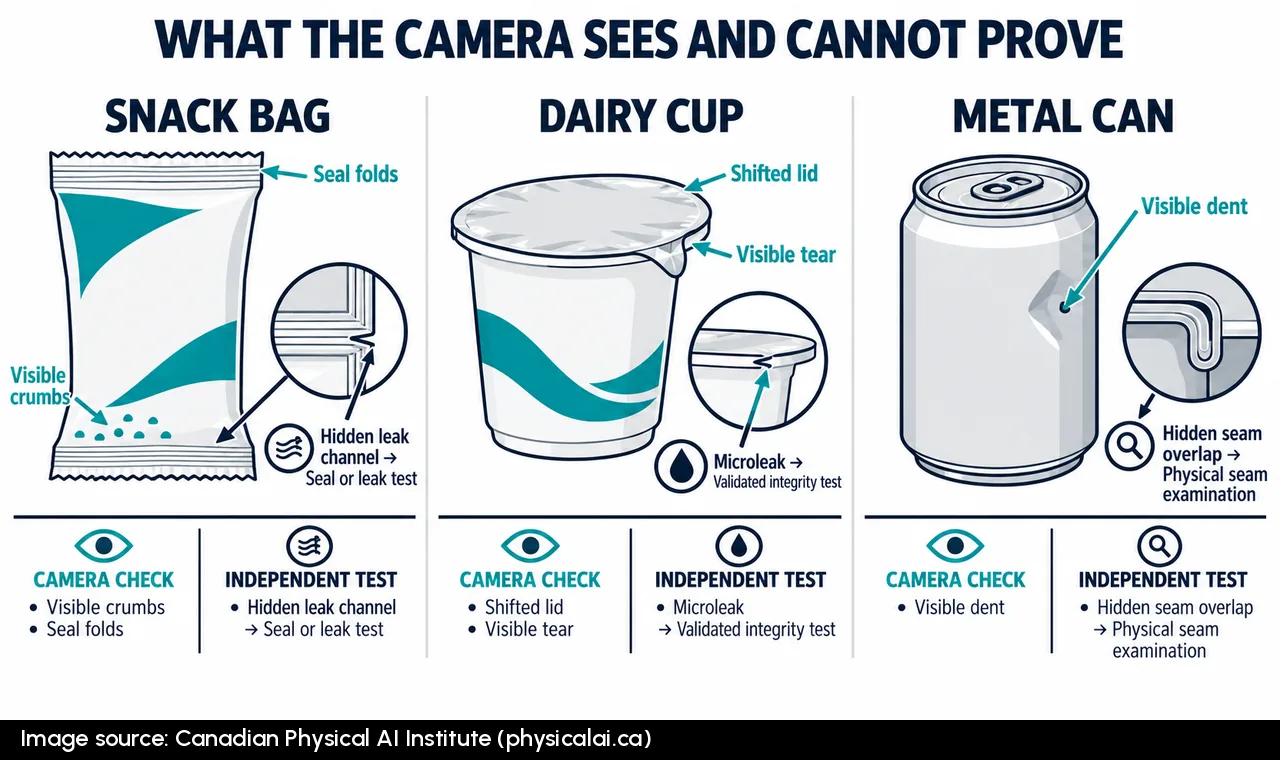
To set that test properly, the manager first separates a visible symptom from the physical condition that matters. A camera can find displaced artwork, wrinkles, missing lids and some damaged seams. It cannot see through an opaque laminate, measure hidden double-seam overlap or prove that a clean-looking heat seal has no microscopic channel. No credible industry-wide visible-defect percentage applies to all three formats.
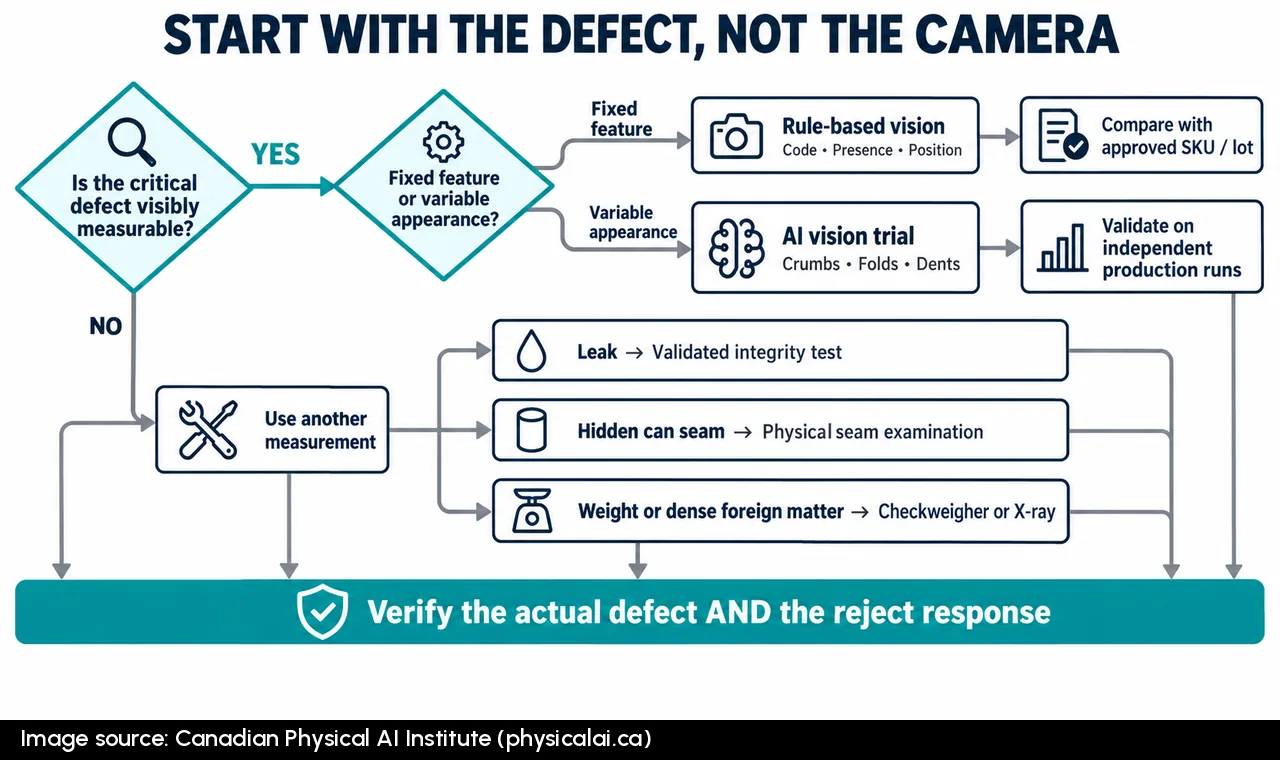
This also determines whether the plant needs AI at all. Rule-based vision often handles fixed barcode, presence, position and dimension checks. Deep learning is more useful when the visual fault varies, as crumbs, folds and dents do. Good-only anomaly detection can flag unfamiliar appearances, but it can also reject harmless changes in film texture. The defect definition comes before the algorithm.
Snack-bag seal inspection offers visible clues, not proof of airtightness
On the snack line, that definition starts at the end seal. Visible crumbs, seasoning, skewed seals, folds and exposed fin-seal irregularities can produce image features worth inspecting. Metallic print and bag inflation alter the image, so inspection needs mixed good and defective packs at full speed. If the camera cannot see the fin-seal face, a better algorithm cannot recover that missing view.
The next distinction is between finding contamination and proving bond quality. Research using hyperspectral images of food-tray seal contamination reported over 94% overall fault-detection accuracy across 11 contaminant types. Specialized imaging may help where RGB contrast is poor, but it cannot prove invisible channels in printed snack film will be detected. Seal-strength or validated leak tests must answer the separate integrity question.
For the same bag, artwork carries a different risk. In September 2025, Old Dutch recalled a potato-chip flavour because of undeclared milk. The notice establishes neither a wrong film roll nor camera preventability. It does prompt the manager to match artwork with the production order and allergen profile, not just read a barcode.
Dairy cups need lid inspection and separate leak detection
That difference between appearance and integrity is even more direct on the dairy-cup line. A top camera can detect missing or off-centre foil lids, wrong flavour artwork, visible wrinkles, exposed tears and unreadable best-before codes. An angled view may reveal product on a rim, but neither view proves seal strength.
The manager therefore makes two specifications, not one: an optical check for known visible lid defects, and an appropriate integrity method for leaks. ASTM F2338-24 describes vacuum-decay testing for applicable packages, including leaks that may not be visible. The method needs validation for that cup and product. A camera sorts visible faults; the leak test establishes integrity.
A different dairy risk explains why the optical check must also look at identity. In an FDA warning letter concerning a 2023 cookie-dough cup recall, peanut-butter dough had been packed into chocolate-chip-labelled containers without a peanut declaration. Reading a perfectly printed label would not reveal the wrong dough inside. Cup and lid checks must therefore stay linked to recipe control and line clearance.
Aluminum cans need all-around views and double-seam teardown
The canning line creates a third boundary. Reflective, curved aluminum can hide dents and make codes difficult to read from one fixed angle. Depending on the defect, the manager considers diffuse light, 360-degree views or 3D measurement of bodies, rims and ends. Even a complete external view remains external.
That limitation matters most at the double seam. CFIA’s metal-can defect guidance distinguishes visible container damage and defects from integrity concerns requiring further examination. In a 2022 FDA warning letter to TreeHouse Foods, investigators documented damaged incoming cans and deficiencies involving seam examinations and responses to abnormal results. The 8.6% incoming-can rejection reflected damage, not false rejects. For this manager, external inspection and qualified double-seam teardown remain separate controls.
A later incident reinforces why that separation matters. In February 2025, selected tuna cans were recalled over an easy-open lid defect that could compromise sealing over time. The recall does not establish whether cameras would have seen the defect. It supports checking the lid and closure risk with a validated method, not declaring a can sound because its visible seam looks normal. The manager must also test camera, PLC tracking and physical removal together at full speed.
Date-code verification may be the simplest first project
Across all three lines, the manager now sees a narrower opportunity. Code presence, legibility and identity often require simpler optics and rules than variable seal defects. A 2013 Del Monte Foods installation checked identifiers and labels at reported speeds up to 1,200 cans per minute. It was conventional code verification, not deep-learning seam inspection, supporting a simpler first project.
Still, reading characters is not the same as validating them. The manager requires a comparison with the active lot, approved SKU and authorized date, plus defined responses to missing or mismatched codes. Research on 2,424 retail food-package images reported more than 95% date-recognition accuracy, but a research recognition score cannot replace a live production-order check. Nor does every shelf-stable can require a best-before date under Canadian rules. The plant must distinguish legal from customer requirements.
Match the sensor to the actual defect
With those package decisions laid out, the manager can compare inspection proposals without comparing unlike promises. This table makes each defect a separate purchasing requirement.
| Defect or question | Can vision see it? | What else to use or verify |
|---|---|---|
| Snack-bag crumbs or visible end-seal folds | Often, with suitable 2D views; AI may help with varied appearance | Seal-strength or validated leak testing for actual integrity |
| Hidden contamination under printed film | Not reliably with ordinary RGB images | Evaluate hyperspectral or other suitable sensing and verify bond integrity separately |
| Dairy-cup missing, shifted or wrong lid | Usually, using position and artwork checks | Compare against active SKU, recipe and line-clearance records |
| Intact-looking cup with a microleak | No reliable visual assurance | Validated vacuum-decay, pressure or other suitable integrity test |
| Can dents, damaged rims or visible seam changes | Often; curved surfaces may need 3D or 360-degree views | Gauges, qualified seam teardown and leak checks where applicable |
| Hidden double-seam overlap or tightness | No | Destructive seam examination or validated equivalent |
| Wrong date, lot code or printed artwork | Yes, if readable and compared with the correct master | Production-order, traceability and allergen-label verification |
| Underweight packs or concealed dense foreign matter | Not reliably through opaque packaging | Calibrated checkweigher or suitable X-ray inspection, respectively |
The table also exposes a common quotation problem: a proposal can cover every package without covering every failure. Before comparing prices, the manager asks for the number of views, enclosure and lighting needs, PLC and reject integration, independent testing, licence terms, data and model access, and revalidation after SKU changes. No defensible typical installed Canadian price covers all these stations. Comparing camera-only quotations is misleading.
False rejects turn an accuracy claim into a shift cost
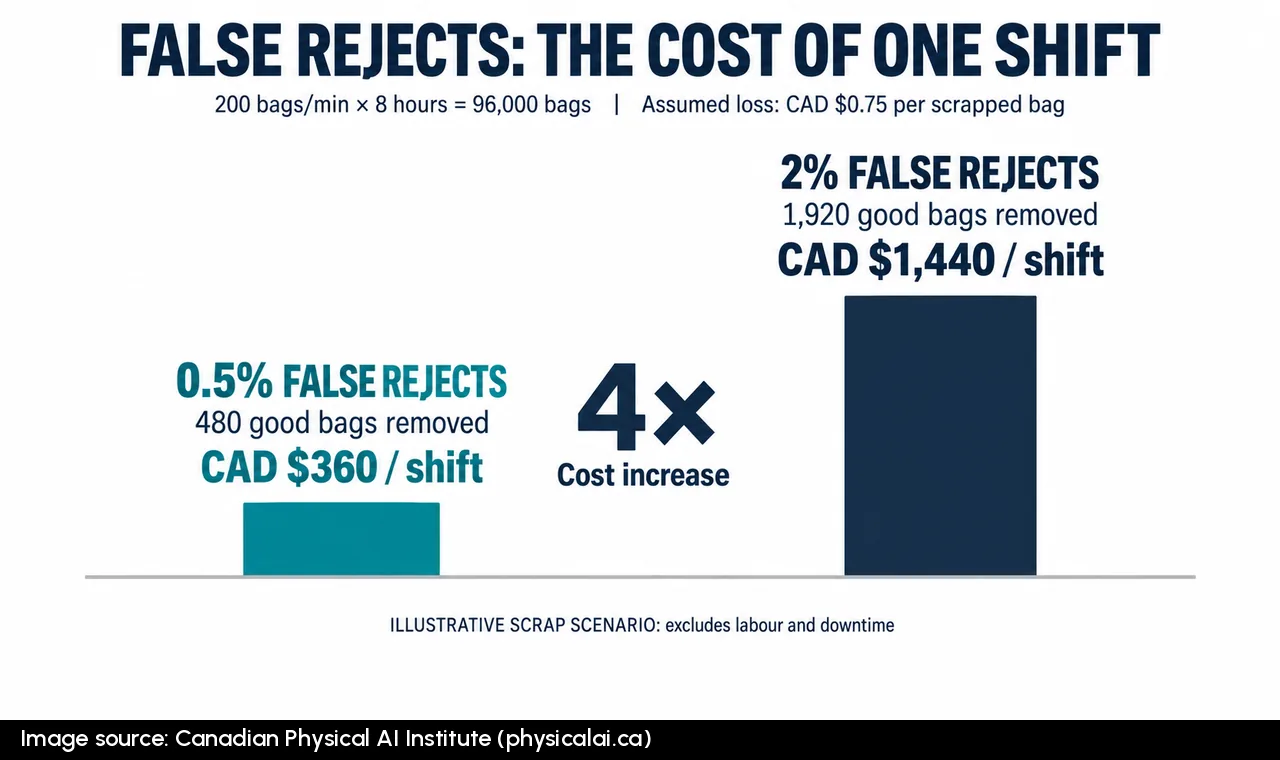
Once the inspection boundary is clear, the manager can price what happens when it is wrong. Illustrative calculation only: suppose the snack line runs at 200 bags per minute for an eight-hour shift, producing 96,000 bags. Assume all are otherwise acceptable. At a 0.5% false-reject rate, 480 good bags are pulled. If QA confirms each must be scrapped at an illustrative CAD $0.75 in product and packaging value, that is CAD $360 per shift before labour or downtime.
The same arithmetic becomes uncomfortable after a lighting or film change. At an illustrative 2% false-reject rate, 1,920 good bags would be pulled, or CAD $1,440 per shift at the same assumed loss. If packs can be safely checked and released, the cost must instead reflect real reinspection and handling, not full scrap. The manager must record false rejects, defect escapes and ejector failures separately. A combined claim of 99% accuracy would conceal all three.
Prove the inspection on the co-packer’s own line
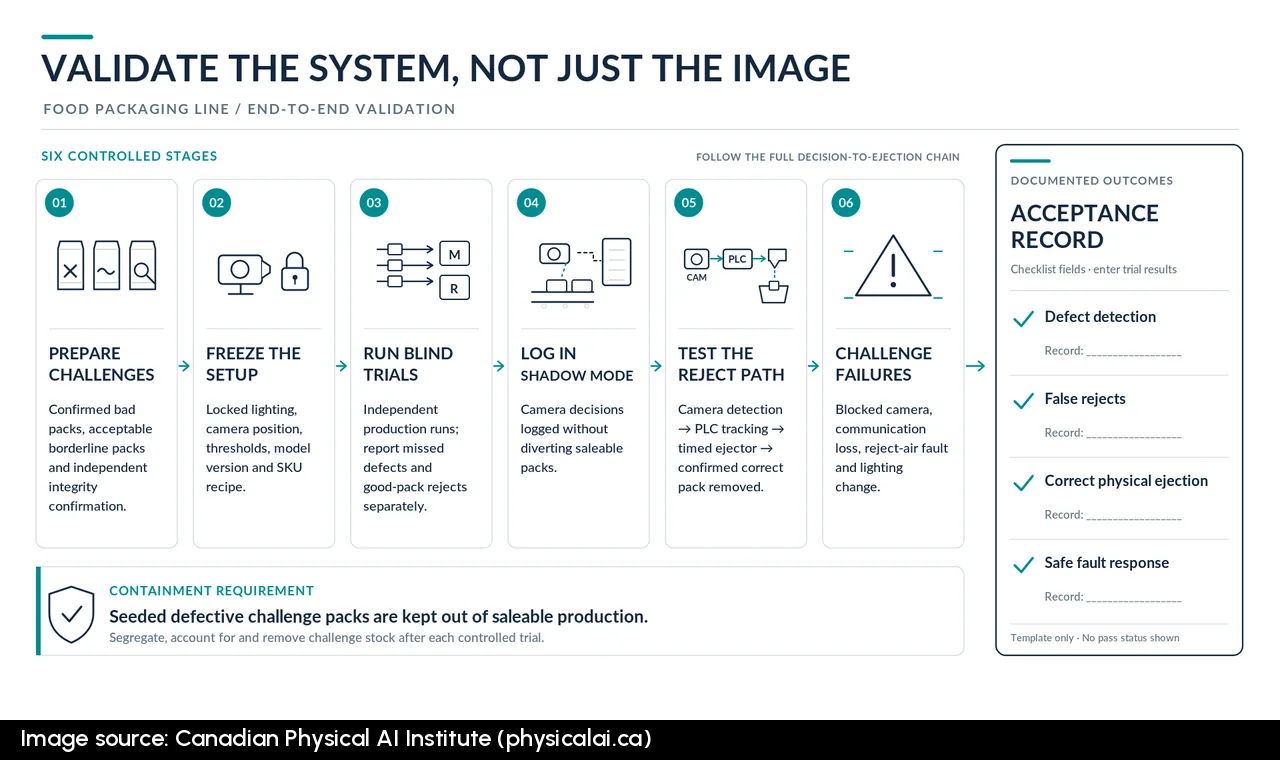
That shift cost gives operations a reason to demand evidence, while missed defects give QA a stronger one. The trial must count each failure separately and keep seeded defects out of saleable production.
Build challenges that resemble real production
For snack bags, QA prepares controlled samples with crumbs in the seal, folds, wrong film and borderline acceptable wrinkles. For cups, the set includes shifted lids, product on rims, wrong artwork and acceptable foil texture. For cans, it includes independently graded dents, damaged ends and visible seam irregularities alongside acceptable reflective variation. Leak faults and seam defects need independent physical confirmation.
Freeze the setup, then measure misses and rejects
With those samples defined, the team captures good production across shifts, film rolls, lid lots, speeds and cleaning conditions. Training and tuning images are kept separate from a blind validation set drawn from independent runs, not adjacent frames of the same fault. No universal image count guarantees performance. Even zero misses in 300 independent known-defective challenges leaves an approximate 95% upper confidence bound of 1% on the miss probability, so zero observed misses is not proof of perfect detection.
Before testing, QA sets acceptance limits by defect, minimum detectable size and SKU. The report must state confirmed defects detected divided by confirmed defects presented, known bad packs passed, and confirmed good packs rejected divided by good packs tested. It must also record no-decision events and whether every reject command removed the correct pack. Critical hazards may need stronger evidence and independent controls.
Test the whole rejection path, not just the image
After a shadow run that logs decisions without diverting product, automation trials the actual reject equipment at normal and maximum speeds. The manager wants to see a blocked camera, loss of communications and a reject-air fault trigger the agreed safe response. A practitioner account of a lighting change ruining a previously working camera view is anecdotal but gives a useful challenge: repeat the trial when room lighting changes.
Changeovers are part of validation, not an afterthought
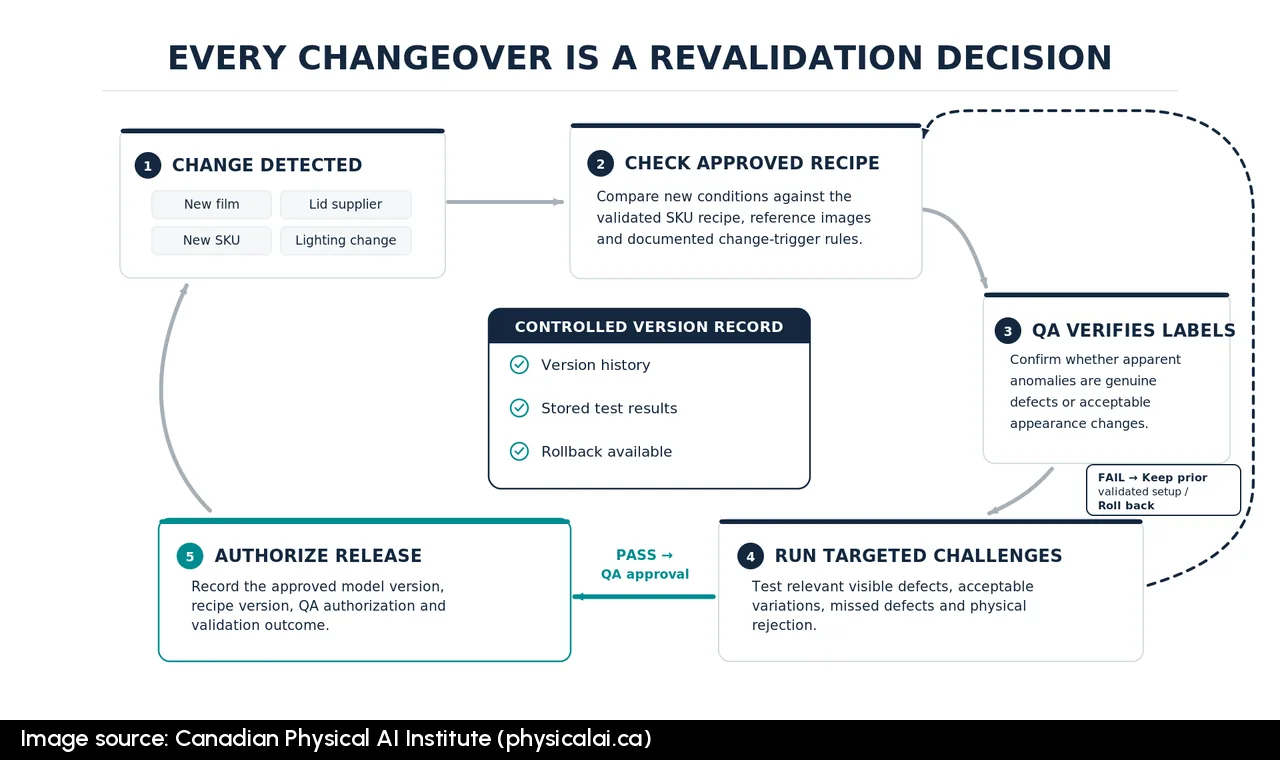
Once the trial passes, the co-packer still changes printed film, lid suppliers, flavours and camera conditions. These can make acceptable packs look different. The manager therefore requires approved SKU recipes, threshold and model versions, stored example images, change-trigger rules and a documented rollback process. Research on cross-domain quality control of retail packaging directly addresses the problem of transferring inspections across different image conditions; it does not supply one universal retraining schedule.
For that reason, retraining is not simply feeding every rejected image back as a defect. QA must first verify labels so harmless glare or a newly approved lid finish does not become learned as failure, or a genuine fault become part of the accepted norm. For packaging defect detection AI, model updates should be approved and challenged before production release. The contract must assign data ownership, offline operation, update rights and rollback responsibility.
Canadian records must reflect what the camera actually controls
Those approvals feed the plant’s HACCP analysis and any applicable preventive control plan under the Safe Food for Canadians Regulations. The manager classifies each check according to its actual food-safety purpose: a wrong-allergen-label check may support a significant preventive control, while dent sorting may be a quality check. AI does not automatically make a check a critical control point; hazard assessment determines its limits and verification.
The records must then show what happened, not just that the software was installed. The manager specifies time-stamped SKU and lot, model and recipe version, inspections, alarms, challenges, overrides, corrective actions and QA authorization. CFIA guidance on preventive-control records describes general two-year retention, with longer requirements for specified processing of shelf-stable low-acid foods in hermetically sealed containers; it does not require every image to be archived automatically. CFIA traceability guidance separately explains applicable two-year traceability records and access obligations. Approved allergen labelling must remain connected to ingredient and product controls, not just camera-readable text.
Start with one defect on one line this quarter
That record design gives the Ontario manager a practical first assignment rather than a three-line capital request. This week, QA can pick the most consequential visible, recurring defect with a clear ground truth, perhaps a wrong or missing date/lot code on one line. Operations can collect representative good and bad packs, map the current reject disposition and estimate loss per shift. Automation can verify camera placement, cycle time and ejector tracking before anyone promises a detection percentage.
Then the manager can request a witnessed trial with defect-specific limits and fault responses. Dairy-cup leak testing and can seam examination remain in the plan because the demonstration never proved those properties. What began as an attractive three-format camera demo becomes a smaller, defensible project: one inspection that solves a defined plant problem, with evidence strong enough to justify the next one.