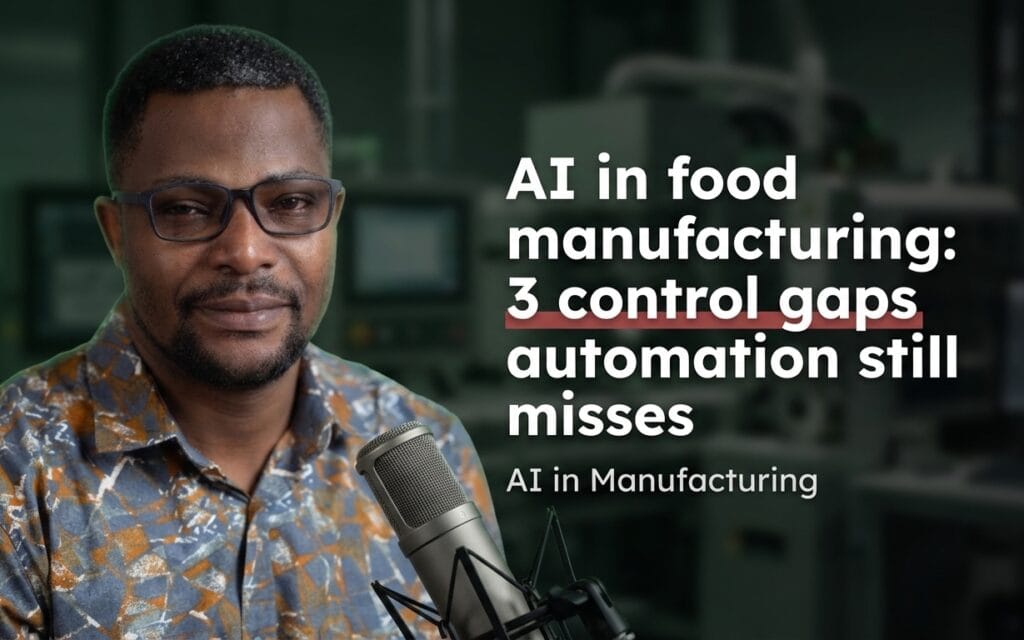
Food and beverage plants often do not need more AI first. They need a tighter control loop: a reliable way to see what is happening, compare it with the approved condition, and trigger the right response. Three recurring gaps expose this problem: a barcode can scan while the wrong SKU runs, periodic sampling can miss packaging drift, and digital records can remain manual even when the line already knows the values.
This article is based on an interview with Isaiah Adegoke, a Quality Assurance Technician with experience in beverage quality, packaging inspection, food safety, and continuous improvement. The examples describe the facilities discussed in that interview; they are not a statistical survey of the food industry.
The short answer: fix the control loop before adding AI
Before choosing a camera, model, or document tool, ask:
- Can the system reliably see the condition?
- Does it know what the correct condition should be?
- Can it trigger the right action when something is wrong?
If one answer is no, the first project may be controls, master data, integration, data capture, or ownership rather than machine learning. A programmable logic controller (PLC), manufacturing execution system (MES) interlock, database comparison, conventional vision check, or better exception workflow may solve the problem more reliably.
The distinction matters because “AI” is often used as a management label for several different capabilities. Exact comparisons, optical character recognition (OCR), fixed-rule vision, statistical process control, anomaly detection, predictive models, and large language model (LLM) document tools have different validation and failure modes. The NIST 2026 roadmap on AI and machine learning for smart manufacturing identifies data management, integration with heterogeneous sensing and control systems, and reliable operation as central industrial-AI challenges.
The three control gaps in one view
| Control gap | What fails | First control to consider | Where AI or machine learning may help |
|---|---|---|---|
| Changeover verification | A readable barcode does not prove that the package belongs to the authorized SKU and recipe | Approved master-data comparison or PLC/MES interlock | Variable artwork, low-contrast codes, placement errors, or difficult visual defects |
| Packaging-process drift | Periodic samples find defects after the process has moved away from its normal condition | Combine inspection results with process data and a defined response | Pattern detection or learned vision when defect appearance varies |
| Manual production records | Operators re-enter values that a trusted PLC, historian, laboratory system, or MES already owns | Auto-capture plus exception review | Extracting legacy records, retrieving evidence, or drafting reviewed summaries |
Gap 1: a barcode can scan correctly while the wrong SKU runs
Changeovers are vulnerable because several actions happen together: the previous product is cleared, new packaging is loaded, recipes change, production wants to restart, and QA needs confirmation. In the interview examples, the weak point was a verification step that depended on memory during a rushed restart, rather than simply a lack of training.
The first control should be deterministic. Instead of asking, “Can I read this barcode?” the system should ask, “Does this code match the SKU, recipe, and packaging configuration that the line is authorized to run?” If the answer exists in approved master data, use a rule, database comparison, or PLC/MES interlock. Do not add a learned model to perform a comparison that should be exact.
Use fixed comparisons, OCR, or conventional vision for exact conditions. Consider learned vision only when appearance or defect patterns vary enough that fixed rules are not practical, for example, variable package appearance, artwork recognition, placement errors, or visual defects that are difficult to define in advance. A first-off-unit workflow can combine deterministic comparison, vision verification, QA evidence, and a release decision.
Why label-verification projects fail
Lighting, glare, condensation, poor inkjet contrast, changing artwork, dirty lenses, reject timing, and incorrect master data can create more operational pain than model accuracy. False rejects affect throughput and trust; a system that repeatedly stops good product may eventually be bypassed or ignored.
Track false rejects and defect escapes by SKU and production run. When the system says a label is wrong, the team should be able to determine quickly whether the problem is the package, master data, sensor, or model. If it cannot, keep the system advisory until the diagnostic path is reliable.
Gap 2: sampling can find seal problems after the process has drifted
Packaging defects show where pattern monitoring or learned vision may add value beyond fixed rules. Operators and QA may already inspect seals, leaks, crushed packs, or cosmetic defects. The gap is timing: a sealing process can move gradually as temperature, pressure, film tension, alignment, speed, or equipment condition changes. Periodic inspection finds the result, but may not identify the change early enough to avoid scrap, holds, or downtime.
Combine inspection results with process data already available from the machine:
- seal appearance;
- temperature and pressure;
- machine speed and settings;
- checkweigher or inspection results;
- reject counts; and
- SKU and production-run context.
An unusual pattern is not automatically a failure. A new SKU, supplier material, speed change, or setup can create an anomaly without creating a quality problem. The alert therefore needs a defined review and response, not an automatic line stop by default. CPAI’s guide to AI soft sensors in food plants covers the related problem of using process data when laboratory results arrive too late to guide the next decision.
Validate warning time instead of chasing one accuracy number
Periodic QA samples may miss the onset of drift, so they should not be the only ground truth. During shadow mode, define a denser review set around alerts, have QA adjudicate held and rejected units, and compare alerts with process changes and subsequent defect results. Record the earliest confirmed drift point, alert time, false alarms, and intervention outcome.
A pack-level alert says, “This pack is bad.” A process-level alert says, “This process is moving into a condition associated with higher defect risk.” The second type of alert gives operations and maintenance a chance to intervene before the line produces a large amount of questionable product, but only if the warning is early enough to change the outcome.
Measure:
- defects per 10,000 units;
- defect escapes and false rejects;
- scrap and product placed on hold;
- packaging-related downtime;
- warning time before a confirmed defect-rate increase;
- successful interventions after an alert; and
- repeat defects after maintenance.
Define each metric before the pilot. Specify which defect classes count as escapes, what makes a reject false, who adjudicates borderline units, what event starts the warning-time clock, and what “successful intervention” means.
Gap 3: digital records still fail when operators re-enter data
Putting a paper form on a tablet does not automatically improve control. If operators still re-enter run times, temperatures, counts, holds, or changeovers manually, the plant has digitized the form without removing the work.
The first target should be auto-capture. If a trusted PLC, historian, laboratory system, or MES already owns the value, use it to populate the record. Operators should spend more time confirming exceptions and less time transcribing machine data.
The next layer is consistency checking:
- entered temperature versus historian temperature;
- recorded run time versus PLC timestamps;
- line-clearance completion versus the actual changeover event;
- verification record versus product-hold status; and
- missing fields versus the expected production sequence.
For a broader data-readiness perspective, see why industrial AI starts with data. For traceability-specific validation, CPAI also covers batch genealogy testing under pressure.
Keep regulatory scope and human review explicit
For U.S. facilities subject to the FDA’s Preventive Controls for Human Food rule, monitoring, corrective actions, and verification activities may require documented records. The FDA’s requirements depend on the facility and applicable exemptions. The Food Traceability Rule concerns covered foods on the Food Traceability List, not every food product. These references are compliance signposts, not site-specific legal advice; Canadian facilities and other jurisdictions require their own regulatory review.
Document tools can assist with unstructured work such as extracting legacy records, retrieving supporting information, organizing shift handovers, or drafting a summary of open deviations. The review boundary must remain clear. For a quality or deviation record, a qualified reviewer should verify source records, correct errors, approve the final entry, and preserve who changed what and why. For critical production values, the source system, not an LLM, remains the source of truth.
Choose the simplest reliable technology
| Need | Prefer first | Escalate only when |
|---|---|---|
| Exact code, recipe, or SKU match | Rule, database comparison, PLC/MES interlock | The condition includes variable visual appearance or difficult-to-define defects |
| Readable text or fixed visual feature | OCR or conventional vision | Lighting and product variation make fixed rules unreliable |
| Early warning from several correlated signals | Statistical monitoring or anomaly detection | There is enough trustworthy history to define normal and confirm outcomes |
| Unstructured documents or handover notes | Search, extraction, and human-reviewed summaries | The source records and review/audit controls are already reliable |
This is why the project should be framed as a control improvement, not a camera or model purchase. The full system includes sensing, data quality, master data, integration, reject logic, sanitation, cybersecurity, maintenance, recovery procedures, operator training, and ownership.
For wider context, see CPAI’s guides on what Canadian plants should automate first and using AI without breaking the line.
Define the response before approving a pilot
| Question | Management decision |
|---|---|
| What is the source of truth? | Approved master data, specification, sensor, PLC, historian, recipe, or QA system |
| What happens on a fail? | Reject, hold, alert, QA review, or controlled stop |
| Who owns the exception? | Operations, QA, maintenance, or engineering |
| Can it run on the real SKU mix? | Validate at production speed, not in a clean demo |
| What happens when confidence is low? | Use a defined human fallback |
| Is every decision recorded? | Preserve evidence for review |
| What happens if the tool is unavailable? | Use a safe manual or conventional-control procedure |
| What authority does the system have? | Advisory, reject-only, hold, or line-stop |
An advisory model and a line-stop interlock require very different validation and recovery evidence. Increase authority only when performance, ownership, and recovery procedures have been proven.
Pilot one failure mode on one line
Avoid launching “AI for the plant.” Choose one recurring failure with a clear owner, a measurable baseline, and a definition of success. CPAI’s failure-mode readiness guide provides a companion framework for deciding whether the problem is ready to automate, while the AI pilot readiness checklist focuses on the production-floor gate.
Start in shadow mode: let the system inspect production and record what it would have flagged without controlling the line. Compare its output with QA findings, rejects, holds, maintenance events, and the defined review set. Then move through controlled stages:
- shadow;
- advisory;
- human-confirmed action; and
- limited automatic action.
Before the pilot begins, define the gate for moving forward: maximum false-reject rate, acceptable escape rate, minimum inspection-workflow availability, required warning time, and no unacceptable impact on throughput or overall equipment effectiveness (OEE).
Set the business baseline before the pilot
Plant managers judge a project by whether the operating process improved, not by a machine-learning score. For label verification, measure wrong-label escapes, changeover verification time, QA interventions, false rejects, and label-related holds. For packaging quality, measure defect escapes, scrap, holds, downtime, warning lead time, intervention success, and complaints. For digital records, measure on-time completion, manual fields per batch, corrections, QA review time, release delays, missing-record exceptions, and lot-trace retrieval time.
Put a monthly value on the baseline before the pilot. CPAI’s guide to where AI can pay off in Canadian food and beverage plants provides a related prioritization lens.
scrap and hold cost + downtime cost + manual review hours × loaded labour rate + complaint or escape cost
Keep implementation, maintenance, and added-review costs separate. A technically accurate model that increases downtime is not a successful plant project. A modest control that prevents a recurring hold, reduces scrap, or removes manual work may be.
Give every pilot a recovery plan
Across all three gaps, plan for bad master data, changing SKUs or suppliers, sensor and vision variation, incomplete process data, model drift, and alerts with no owner. Treat these as operating controls, not implementation details.
Three mistakes are especially expensive:
- Using AI where a deterministic control is better. If the answer should be exact, prefer an exact rule.
- Measuring the model instead of the operating result. Accuracy does not pay for scrap, downtime, holds, or labour.
- Giving the system more authority than the evidence supports. Advisory, reject-only, hold, and line-stop modes need different validation thresholds.
Frequently asked questions
Should every food-manufacturing quality problem use AI?
No. Start with the simplest reliable control. Use a rule, master-data comparison, interlock, OCR check, or conventional vision when the expected condition is exact. Consider machine learning when the appearance or process pattern varies enough that fixed rules are not practical and the plant can validate the result.
What are the three control gaps?
They are wrong-SKU risk during changeovers, late detection of packaging-process drift, and manual re-entry of production or QA data that already exists in trusted systems.
How should a plant pilot AI on a production line?
Choose one failure mode, define a baseline and owner, run in shadow mode, compare alerts with a defined review set, and increase authority gradually from advisory to human-confirmed and then limited automatic action.
Can an LLM be the source of truth for a quality record?
No. An LLM can assist with extraction, retrieval, or a draft summary, but critical production values and final quality records should be checked against the authoritative source system and approved through the plant’s review process.
A useful AI project closes a control gap without creating a new one
A useful AI project in a food or beverage plant closes a small but expensive gap. The right packaging is checked against the authorized product. A sealing process is flagged early enough to prevent a defect burst. A production record fills itself from trusted process data instead of being reconstructed later.
Operators, QA, maintenance, and engineering still own the process. The difference is that they spend less time compensating for controls that depend on memory, periodic checks, and manual transcription.
Before approving a pilot, use CPAI’s failure-mode readiness guide to map the recurring loss, owner, evidence, and recovery procedure. The right question is not “Where can we add AI?” It is: “Which recurring failure is costing us money, time, or control, and what is the simplest reliable system that can remove it?”
Sources and scope
- NIST: 2026 Roadmap on Artificial Intelligence and Machine Learning for Smart Manufacturing
- FDA: FSMA Final Rule for Preventive Controls for Human Food
- FDA: Food Traceability Rule reference
The regulatory links above are provided for orientation and do not replace advice from the facility’s qualified food-safety, regulatory, or legal professionals.