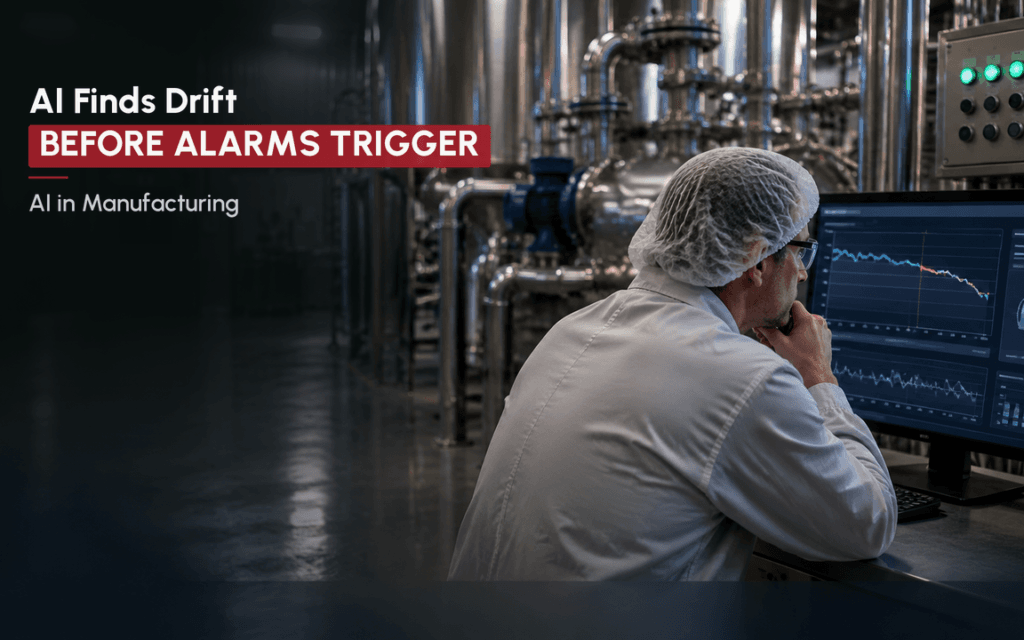
AI anomaly detection in manufacturing uses historical production and sensor data to learn normal operating patterns and identify unusual changes, even when individual measurements remain within their alarm limits. Instead of programming a rule for every possible fault, plants can monitor relationships between signals. The challenge is turning those findings into useful warnings without creating more nuisance alarms.
Consider a hypothetical juice-bottling plant in Ontario. Leah, the plant’s reliability lead, is investigating a transfer pump that has caused intermittent production interruptions.
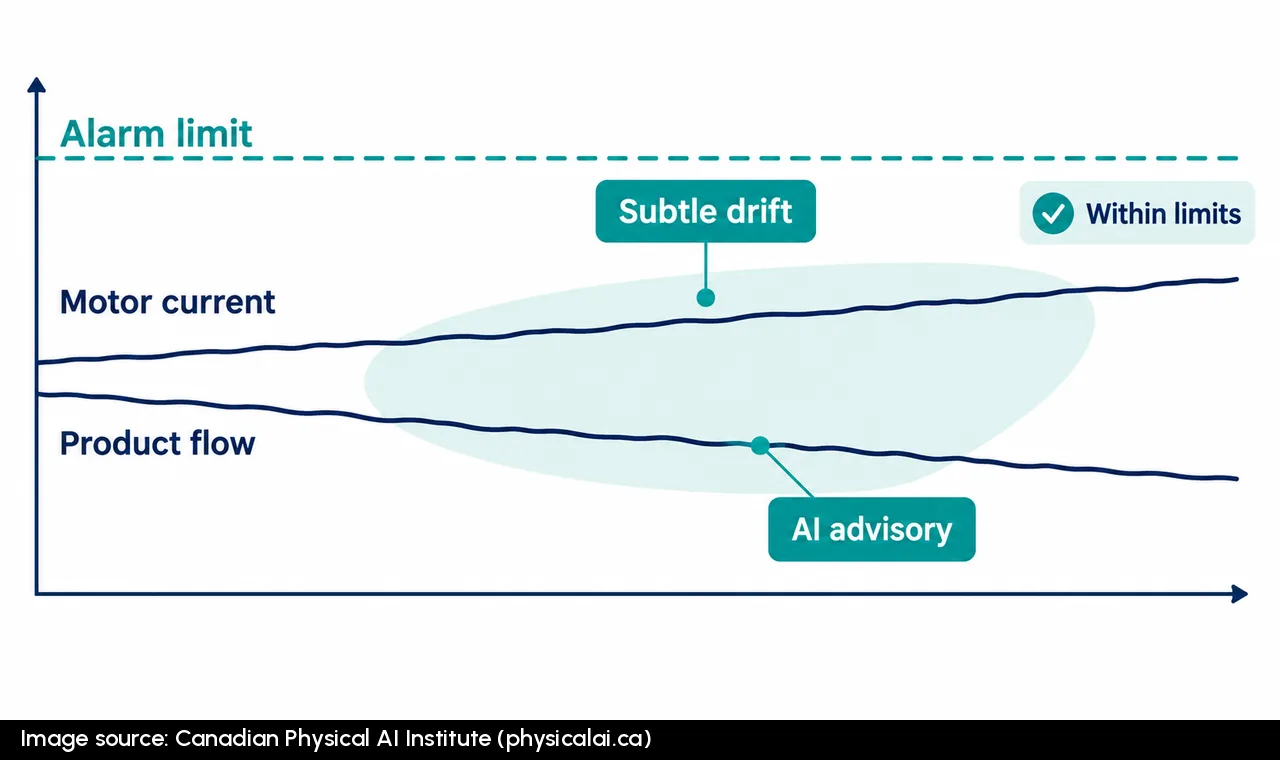
The pump has been running within its configured limits. Motor current is acceptable, discharge pressure has not triggered an alarm, and product flow remains within its permitted range. Yet when Leah reviews several shifts together, she notices that the pump is drawing slightly more current to deliver slightly less product.
A conventional PLC alarm responds when a defined condition occurs. An AI anomaly detector could recognize that the pump is behaving differently from comparable periods of healthy operation, giving Leah an opportunity to inspect the equipment before a breakdown.
The change might also reflect a legitimate recipe change, a different product viscosity or a drifting instrument. Finding an unusual pattern is useful only if the plant can establish what it means and act on it without overwhelming operators.
This guide focuses on industrial sensor and time-series data from process equipment. Image-based anomaly detection uses camera images and requires a different data pipeline and validation approach.
How AI Finds Problems That Fixed Alarm Rules Can Miss
Leah’s plant already collects most of the information needed to investigate the developing pump problem. Its PLC and historian record current, pressure, flow and machine operating states, but the way those measurements are interpreted determines what the plant can detect.
A conventional alarm evaluates a condition configured by an engineer. For example, it might activate when motor current exceeds a defined value for a specified period.
That arrangement works well when the undesirable condition and its appropriate boundary are known. The controller can evaluate the condition consistently and trigger an established response. A developing pump problem, however, might appear as a gradual change in several measurements before any one of them crosses its individual limit.
Research on multivariate statistical process monitoring explains why evaluating relationships among variables can reveal process deviations that individual measurements do not adequately describe.
The distinction becomes clearer when the two approaches are placed alongside each other.
| Question | Fixed PLC/SCADA alarm rules | Learned AI anomaly detection |
|---|---|---|
| What does it examine? | Specific measurements, states or conditions | Measurements, patterns and relationships learned from data |
| How is abnormal behaviour defined? | Engineers configure limits and logic | A model establishes expected behaviour from reference data |
| What does it detect well? | Known hazardous, unacceptable or operational conditions | Unusual combinations, gradual drift and unfamiliar operating patterns |
| What can it miss? | Changes that remain within configured limits | Faults not visible in the available data, or changes the model incorrectly considers normal |
| What configuration is needed? | Alarm conditions, priorities, delays and required responses | Data preparation, operating context, model configuration and alert policy |
| Who interprets the result? | An assigned operator following an alarm response | An assigned engineer, operator or technician investigating a deviation |
| Best use | Established operating alarms and protective functions | Early warnings, diagnostics and condition monitoring |
| Main limitation | Cannot detect patterns that have not been represented in its logic | Can mistake legitimate operating changes for faults |
The two approaches are complementary. Leah should retain the pump’s existing high-current alarm because it protects against a defined condition, while the model looks for additional evidence of degradation.
Why anomaly detection without manual rules still needs thresholds
The phrase anomaly detection without thresholds can create a misleading expectation. A learned detector generally calculates how different current behaviour is from the reference data. That measure might be an anomaly score, a prediction error or a reconstruction error.
The plant must still decide when the difference warrants attention. Leah might require a deviation to persist during stable production before generating a maintenance advisory, while a brief change during startup would receive different treatment.
This is an alert decision policy, even though nobody has programmed a separate PLC rule for every possible pump failure.
A 2025 fermentation anomaly-detection study illustrates the distinction. Researchers trained models on normal operating batches and used percentile-based thresholds to decide when reconstruction errors indicated unusual behaviour.
The models could identify deviations without labelled examples of every possible contamination event, but they still needed preprocessing, model configuration and criteria for flagging anomalies. For Leah, the benefit is the ability to monitor complex behaviour without manually describing every potential fault.
That capability depends on what the model learns as normal.
 Reader offer · ends November 11Where is the hidden cost in your factory?Watch it with 3 months of Premier free →
How a Model Learns Normal Production Behaviour
Leah initially considers feeding every available historian tag into an anomaly detector. The plant has years of recorded production data, but a large collection of measurements is not necessarily a reliable description of normal operation.
Historical records can contain breakdowns, cleaning cycles, partial startups, missing measurements and periods when the process was operating under different conditions. Training indiscriminately on that history could teach the model that abnormal operation is normal.
A better starting point is to identify the measurements that describe the pump’s expected behaviour and establish the conditions under which they should be compared.
Start with existing PLC and historian data
For the juice transfer pump, Leah would begin with motor current, flow, discharge pressure, product temperature, commanded speed and actual operating state. Together, these measurements describe the pump’s load and how its behaviour changes with throughput.
She would connect them to production-system information such as product identity, batch number, recipe, line speed, start and stop times, and cleaning status. Maintenance records provide another layer by showing when the pump was inspected, repaired or replaced, allowing unusual historical behaviour to be compared with what technicians actually found.
An April 2026 PLC practitioner discussion illustrates the feature-selection problem. A contributor working with more than 150 industrial features described difficulty identifying the variables relevant to motion mismatches, delayed cycles and inconsistent sensor behaviour.
That account is not a validated performance study. It illustrates why adding signals can increase complexity without improving the information available for a decision.
Leah should select a manageable group of relevant measurements, confirm their engineering units and timestamps, and check whether their quality is sufficient. In the 2025 fermentation research, investigators addressed invalid timestamps, missing data, uneven measurements and feature construction before evaluating detection models.
A model receiving frozen or incorrectly synchronized measurements could produce an impressive anomaly score for what is actually an instrumentation problem. Sensor-quality checks therefore belong in the design from the beginning.
Separate recipes, speeds, CIP and changeovers
The pump’s operating signature depends on what the plant is producing. A reduced filling-line speed, for example, could change the normal flow and motor-load relationship without indicating mechanical deterioration.
If production states are mixed together, the model may report unusual behaviour whenever the plant changes products.
Cleaning-in-place, or CIP, creates another distinct operating mode. Flow, temperature and equipment sequences during cleaning are intentionally different from those used during production. Research published in 2018 specifically examined anomalies in the CIP operations of an industrial brewery fermenter, demonstrating that cleaning operations can be assessed for their own deviations rather than treated as ordinary production.
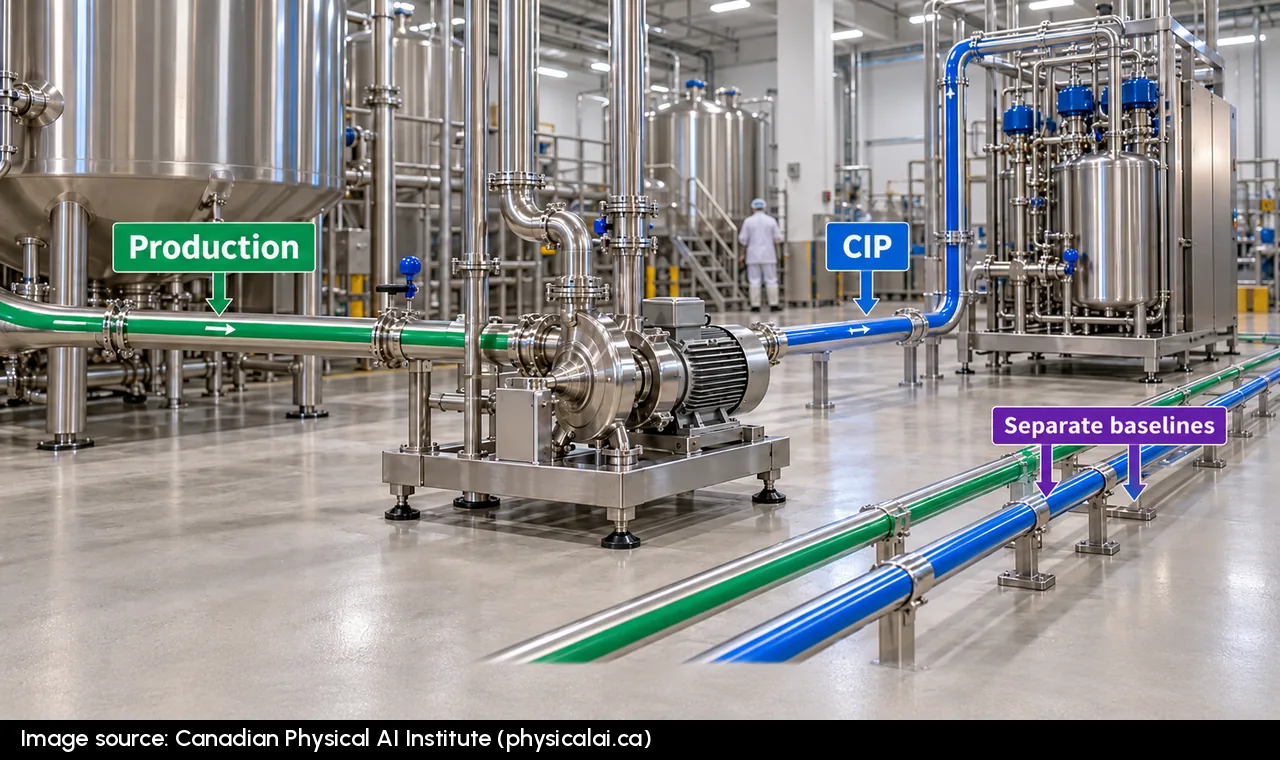
Leah should therefore compare pump behaviour during juice transfer against an appropriate production baseline and evaluate cleaning sequences against a cleaning baseline. Her plant could use separate operating-mode baselines or activate certain detections only when the process is in a validated running state.
The same reasoning applies to packaging changeovers. A temporary stop while bottle-handling equipment is adjusted is not automatically a developing fault.
Plants that have difficulty separating these events should first examine their changeover time and records, because unclear production states undermine both conventional reporting and learned monitoring.
Choose the simplest model that answers the question
Once Leah has suitable data, she can compare approaches without assuming that the most complex algorithm is best.
A statistical baseline might be sufficient if the pump’s expected current at each operating speed follows a stable relationship. Principal component analysis, or PCA, can help identify unusual combinations among correlated process measurements. Isolation Forest can identify observations that differ unusually from common combinations in prepared sensor data.
An autoencoder can learn to reconstruct normal measurements and use reconstruction error to flag deviations. A forecasting model can compare the next expected measurement with what actually occurs, making it useful for some forms of gradual drift.
These are established anomaly-detection approaches described in the general anomaly-detection literature and industrial multivariate time-series research.
Their limitations matter as much as their capabilities. A basic statistical approach may miss complex relationships, an autoencoder may identify a strong deviation without explaining its physical cause, and a forecasting model may react to a legitimate operating transition.
Leah should compare candidate methods using her own plant’s data, including their false alerts and the evidence they provide for investigation. That comparison also clarifies why detection is not the same as diagnosis.
What Production Problems Can AI Anomaly Detection Reveal?
The pump’s measurements give Leah a useful starting point, but an anomaly alone cannot establish whether the cause is an impeller problem, a restriction, an ingredient change or a faulty sensor.
Similar monitoring can help identify unusual operating relationships in other equipment. A filler may show unexpected fill-weight variation, a heat exchanger may behave differently under comparable process conditions, and refrigeration equipment may consume more energy relative to its operating demand.
AI can identify such departures where suitable measurements and reference data exist. It cannot guarantee a specific diagnosis or an early warning for every failure.
The difference between detecting a deviation and predicting quality is particularly important in food processing. A quality-prediction model estimates a property such as moisture, density or fill weight. An anomaly detector asks whether current process behaviour differs from the expected pattern.
Both can support better decisions, but they answer different questions. For processes where laboratory results arrive after the production decision, AI soft sensors in food manufacturing provide a related approach. This distinction helps Leah avoid choosing an anomaly detector when her actual need is to predict a specific quality measurement.
What real food and beverage evidence shows
Leah has several research examples against which to judge claims made for the proposed system.
At Britvic’s Rugby beverage facility, condition monitoring identified a developing pump problem that technicians could address before the anticipated failure disrupted production.
The supplier-reported estimate was approximately 288,000 bottles of prevented production loss. The site’s existing pump condition-monitoring guide examines that example in the context of choosing which assets to monitor first.
This is a useful example of maintenance action following a warning, but it does not independently verify that the same savings or alert performance would occur at Leah’s plant.
Research provides another kind of evidence. In a 2025 milk-coagulation study, investigators combined Raman spectroscopy and multivariate monitoring to detect abnormalities involving temperature control and rennet concentration.
Under the studied experimental conditions, reported detection accuracy reached up to 99.8%, with a minimum detection time of seven minutes after rennet addition. That result demonstrates a process-monitoring capability beyond rotating equipment, but it does not establish commercial dairy-plant ROI, long-term nuisance-alert rates or automatic food-safety compliance.
A 2024 food-industry monoblock-machine study offers a different example. Researchers combined vibration measurements and production stoppage records to evaluate predictions within a three-minute window.
That work used supervised stoppage prediction, not a normal-only anomaly detector. It nevertheless demonstrates why linking sensor signals with actual production consequences matters.
Taken together, these examples show that learned methods can identify useful process or equipment information that conventional monitoring may not make obvious. They do not establish that every plant will obtain usable warnings or that those warnings will arrive early enough to change a maintenance decision.
That uncertainty becomes more serious when the existing control system already produces too many alarms.
Why Adding AI to an Alarm-Flooded Plant Can Make Things Worse
Before introducing live AI notifications, Leah reviews the bottling plant’s current alarm history. She wants to know how many alarms operators already receive, which ones repeat frequently, and whether every alarm has a defined response.
Without that review, a new anomaly-detection system could increase the number of warnings without improving anyone’s ability to respond.
What ISA-18.2 and EEMUA 191 say about alarm workload
The ANSI/ISA-18.2 alarm-management framework establishes a lifecycle covering alarm philosophy, identification, rationalization, design, operation, monitoring, maintenance, management of change and auditing.
The corresponding international standard, IEC 62682:2022, addresses alarm management for process industries, including continuous, batch and discrete operations. Both frameworks focus on alarms that communicate conditions requiring an appropriate operator response.
EEMUA Publication 191, whose fourth edition was released in 2024, provides additional industrial guidance on alarm-system design and management.
For Leah, the immediate question is whether the existing alarm workload is manageable. The commonly cited ISA alarm-management performance references provide a basis for that review.
| Alarm workload measure | Common reference value | Practical meaning |
|---|---|---|
| Desirable average rate | About 1 alarm per operator per 10 minutes | Reference for manageable steady operation |
| Higher average rate | About 2 alarms per operator per 10 minutes | Greater workload, not the preferred target |
| Alarm-flood onset | More than 10 new alarms in 10 minutes | Common criterion for identifying a flood |
| Alarm-flood ending condition | Fewer than 5 new alarms in a subsequent 10-minute period | Reference for identifying flood recovery |
These are industry performance references, not universal legal limits for Canadian food factories. They also describe formal alarm-system performance, and an AI maintenance advisory is not automatically a formal process alarm.
Repeated advisories can still interrupt the same people responsible for production, creating workload even when the notifications arrive through a separate interface.
The alarm-flood lesson from Milford Haven
The danger of overwhelming operators is not theoretical.
On July 24, 1994, an explosion and fires occurred at the Texaco refinery in Milford Haven, Wales. The UK Health and Safety Executive’s incident account identified several equipment, control-system and management failures. Excessive emergency alarms reduced the effectiveness of operator response, while inadequate process overviews complicated diagnosis.
The regulator’s alarm-management guidance describes operators facing a barrage of alarms for five hours before the incident.
Although this was neither an AI incident nor a food-manufacturing facility, its lesson applies to Leah’s design decision: more indications do not necessarily provide better information during a developing process problem.
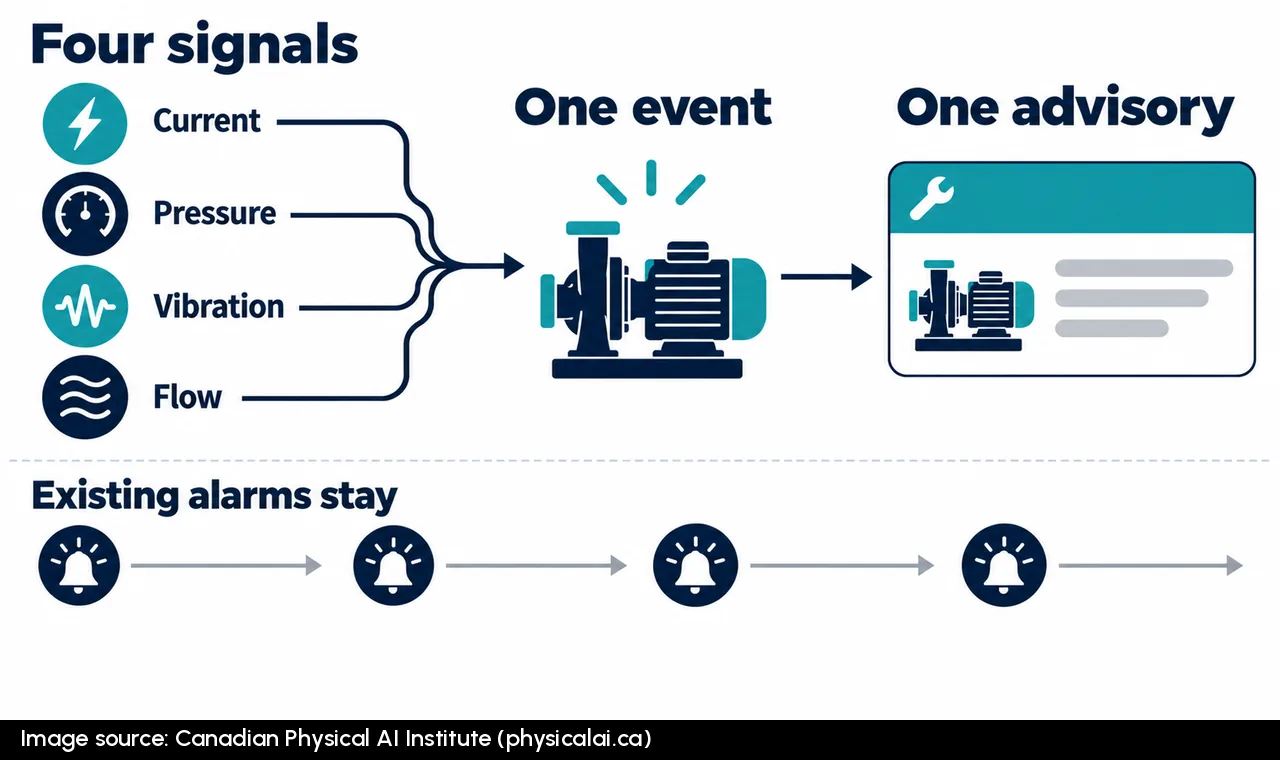
If a failing pump generates separate AI warnings for current, pressure, vibration and flow, an operator might receive four interruptions relating to one underlying event. A better approach is to group related signals into one qualified finding and direct it to the person who can investigate it.
Decide what deserves an operator alarm
Leah establishes a clear distinction among the outputs her system might produce.
A statistical anomaly can remain an engineering observation. A persistent, explainable equipment deviation can become a maintenance advisory, while a finding requiring inspection can enter the plant’s existing maintenance workflow.
An indication that genuinely requires timely operator action may qualify as a formal process alarm, but only after the necessary alarm-management review.
The AI system should not independently suppress established alarms, acknowledge them on an operator’s behalf, modify protective interlocks or authorize product release.
A 2017 thermal power-plant study reported eliminating approximately 98% of nuisance alarm occurrences without affecting true alarms through conventional alarm-cleanup techniques. Although this was an adjacent industry rather than a food-plant AI implementation, the result reinforces that existing alarm rationalization may solve some of Leah’s workload problems more directly than another model.
Once alarm ownership and notification routing are clear, she can examine the ways learned monitoring itself might fail.
How Anomaly-Detection Pilots Fail on Real Production Data
Leah’s first concern is false positives. A detector can correctly recognize an unusual measurement pattern and still generate an alert that nobody should act on.
Technically valid detections are not necessarily useful maintenance findings.
False positives consume inspection time
Suppose the pump changes its operating behaviour during a normal recipe transition. The model might calculate a high anomaly score because the pattern differs from stable-production data, but interrupting maintenance for a transition that requires no intervention is still a nuisance.
A 2026 study on false-positive rates argues that anomaly-detector reliability should be assessed using absolute false-positive counts and operational alarm rates, not classification accuracy alone.
That is the measurement Leah needs. A detector producing few false positives as a percentage of thousands of sensor observations could still interrupt the plant repeatedly during every shift.
An unverified January 2026 industrial maintenance discussion described an offshore monitoring pilot that reportedly issued severe warnings for months, while subsequent inspections found no corresponding defects.
The account cannot establish a general AI failure rate. It illustrates how repeated unconfirmed warnings can weaken confidence and consume maintenance resources.
Recipe and packaging changes create model drift
False alerts are not always caused by a poorly designed initial model. Sometimes the model becomes outdated because the process changes.
Leah’s plant might introduce a different juice formulation, replace a pump component, modify a bottle-handling mechanism or change operating speeds. A baseline trained before those changes may no longer represent healthy operation.
This is known as concept drift. A 2024 industrial study involving an ultrasonic sieve machine examined anomaly detection under changing conditions and investigated continual learning as a response.
Automatically retraining on recent data introduces another risk. If a pump is slowly deteriorating, a model that continuously accepts all new behaviour as normal could learn the deterioration instead of warning about it.
Leah therefore needs a controlled process for reviewing and approving model changes.
Missing states and black-box scores undermine trust
A model that does not know when the plant is cleaning, starting up or changing products will generate avoidable uncertainty. The problem may be missing context rather than the algorithm.
In a 2025 manufacturing practitioner discussion, contributors described difficulties involving inconsistent timestamps, absent machine states and AI projects that became unused because operators did not trust the results.
These were self-reported experiences, not independently verified deployment outcomes.
An alert reading only “anomaly score 0.94” gives Leah little basis for deciding whether to inspect the pump. She needs to test the finding against process knowledge and the historical record rather than treat the score as a diagnosis.
That difference should become a formal procurement requirement rather than an optional demonstration feature.
Eight Must-Have Requirements Before Choosing an AI Anomaly-Detection Partner
Leah now has enough information to prepare a technical acceptance checklist for the hypothetical Ontario plant. The checklist is designed to prevent an attractive model demonstration from becoming an expensive monitoring system that the plant cannot operate, maintain or trust.
Each requirement must be demonstrated with the plant’s own conditions, not merely confirmed in a sales presentation.
1. Prove the system runs at the edge
The first requirement is local processing. Leah wants anomaly detection to continue on plant-controlled infrastructure without depending on an external cloud connection.
A supplier should demonstrate that the necessary data collection, inference, notifications and record retention continue when permitted internet connections are disconnected. The system should obtain production measurements through an approved, read-only integration rather than requiring unrestricted access to PLC controls.
This reflects the reliability and security considerations in NIST’s OT security guidance.
Edge deployment is not automatically secure. Network segmentation, access control, updates and remote support still require review.
The acceptance test is whether the plant remains in control of monitoring operations when outside connectivity is unavailable.
2. Keep data ownership and collection rights explicit
Local processing does not automatically prevent external collection.
Leah needs contractual terms identifying ownership of raw measurements, derived features, model outputs, alert histories and exported records. The agreement should prohibit unauthorized collection, retention or reuse of production data, including training models for other customers.
Recipes, operating schedules and equipment behaviour can reveal commercially sensitive information. A 2026 Canadian SCADA practitioner discussion raised similar concerns about outside access, data retention and remote connections.
That discussion is practitioner opinion, not Canadian legal guidance. The Office of the Privacy Commissioner of Canada’s third-party guidance addresses accountability when personal information is processed by service providers, but it does not establish a blanket rule requiring all industrial telemetry to stay in Canada.
For Leah, keeping plant data on site is a procurement requirement that must be written into the contract and technically verified.
3. Require model version control and rollback
The next issue is what happens after the monitoring system has been running successfully.
Suppose Leah approves a new model following a pump replacement, and the updated model suddenly starts generating frequent warnings. The system must allow her to identify the model version responsible, compare its behaviour with the previous version and restore the earlier approved configuration.
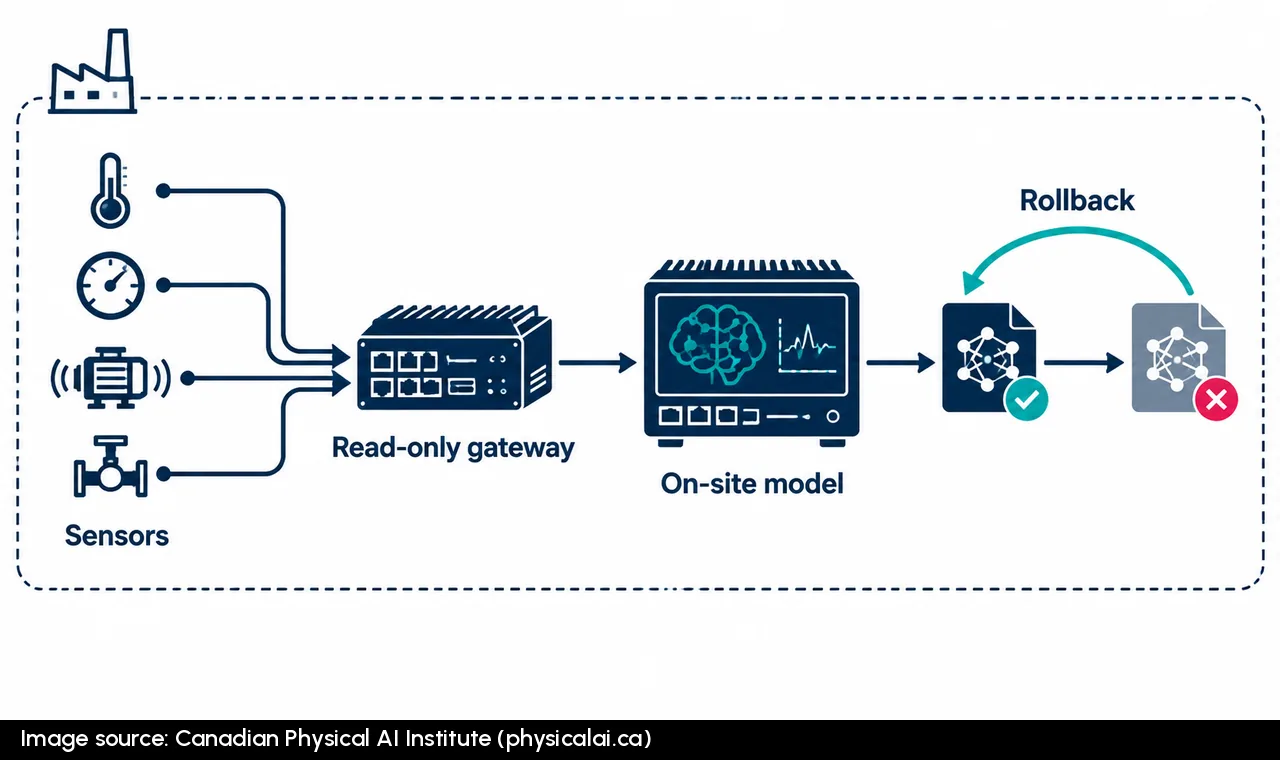
That requires retained model versions, documented alert settings, change approvals and a tested rollback procedure. Without rollback, a model update can become a production support problem rather than a controlled improvement.
A supplier should demonstrate the entire process during acceptance testing, including recovery from a deliberately introduced bad configuration.
4. Show which tags caused every alert
Leah will not approve a system that reports only an anomaly score.
For each actionable finding, she needs the equipment identity, production mode, affected measurements, actual values, expected behaviour and the time over which the deviation developed.
The display should make it possible to distinguish a changed current-flow relationship from a missing or frozen sensor. Research on interpretable industrial predictive maintenance supports relating analytical findings to measurable production attributes.
The explanation does not need to claim a definitive root cause. It needs to give the technician enough evidence to select a reasonable verification step.
5. Connect qualified findings to existing alarm and CMMS workflows
An alert that remains on a separate dashboard may never change a maintenance decision. Leah therefore requires an explicit route from the AI observation to the plant’s established process.
A qualified pump advisory might generate a maintenance review task. A technician would then confirm the finding, reject it or escalate it into planned maintenance, preserving the original anomaly evidence and eventual inspection result.
Formal operator alarms must still follow the site’s alarm philosophy and established approval procedures. That separation prevents every statistical deviation from becoming another HMI alarm while ensuring useful findings do not disappear.
6. Assign responsibility for retraining after process changes
Leah’s plant regularly changes recipes, packaging formats and equipment settings. Each change creates a question: does the existing baseline remain valid?
The supplier agreement must identify who assesses that question, who prepares model updates, who checks the revised model against old incidents and who authorizes deployment.
The procedure should also specify what happens when the responsible person is unavailable or the supplier relationship ends. Without assigned ownership, routine production changes can gradually make the monitoring system unreliable.
7. Demand backtesting on the plant’s own incidents
Generic accuracy results are insufficient. Leah wants the proposed system evaluated against recorded pump problems, repair dates, production interruptions and the alarms available at the time.
The test must establish when the model would have warned, which events it missed and whether the warning preceded the existing alarm by enough time for useful intervention.
Research on evaluating unsupervised predictive maintenance emphasizes the limitations of conventional anomaly metrics and the need to evaluate meaningful events rather than individual abnormal data points alone.
If the model identifies only problems that the existing system already reveals, its incremental value is limited.
8. Agree on a false-alert budget with operators
Even a technically successful detector can fail if the plant cannot handle its notification workload.
Leah must agree with operations and maintenance on acceptable false or nonactionable alerts per shift, expected investigation time and the escalation procedure. The budget should be tested across normal production, CIP, startups and product changes.
There is no universal acceptable AI false-alert rate established for food plants in the research reviewed. The plant must decide what is manageable based on staffing, process risk and the value of the potential warnings.
The checklist connects model performance with the people expected to use it. The next step is to test those requirements before installing live notifications.
A Practical Pilot Plan for a Canadian Food Plant
Leah’s pilot should answer one question: can the proposed detector identify a meaningful production problem earlier or more clearly than the plant’s existing controls, with an acceptable amount of additional work?
She should not begin by monitoring every asset. Instead, she chooses the transfer pump because it has usable history, known interruptions and a maintenance team capable of responding.
Step 1: Define the failure and collect evidence
Leah starts with the pump’s documented interruptions and inspection history. She identifies relevant historian measurements, equipment states, recipe records, existing alarm timestamps and maintenance findings.
The goal is to establish the plant’s actual baseline. For each known incident, she records what happened, when it was recognized, what action was taken and whether production was lost.
This prevents counting an AI alert as valuable when routine inspection or the existing alarm system already identified the problem.
Step 2: Train and test in chronological order
Leah separates earlier production data used to develop the model from later records used to evaluate it. The model should not learn from future events that would have been unknown when the warning was supposedly generated.
She then replays the evaluation data in time order. The test includes healthy operation, known pump problems, different juice recipes, startup periods and CIP.
For every candidate alert, the team records whether the detection corresponded to a meaningful issue, when it occurred and whether a maintenance action would have been possible. The evaluation must also identify missed incidents and false or nonactionable notifications.
Step 3: Run in shadow mode before live alerts
After historical testing, the model runs against current production data without interrupting operators. Leah reviews detections with the responsible maintenance and production personnel and records their decisions.
For a broader deployment-readiness review, the plant can also use the site’s AI pilot readiness checklist, which addresses operational responsibilities when an AI system is wrong.
The pilot should conclude with a written decision to deploy, revise or stop. A good demonstration is not sufficient grounds for expansion.
Worked Example: Does the Early Warning Justify the Extra Alerts?
Leah needs an understandable way to present pilot results to management. The following numbers are entirely illustrative. They do not represent a measured food-plant result or an industry benchmark.
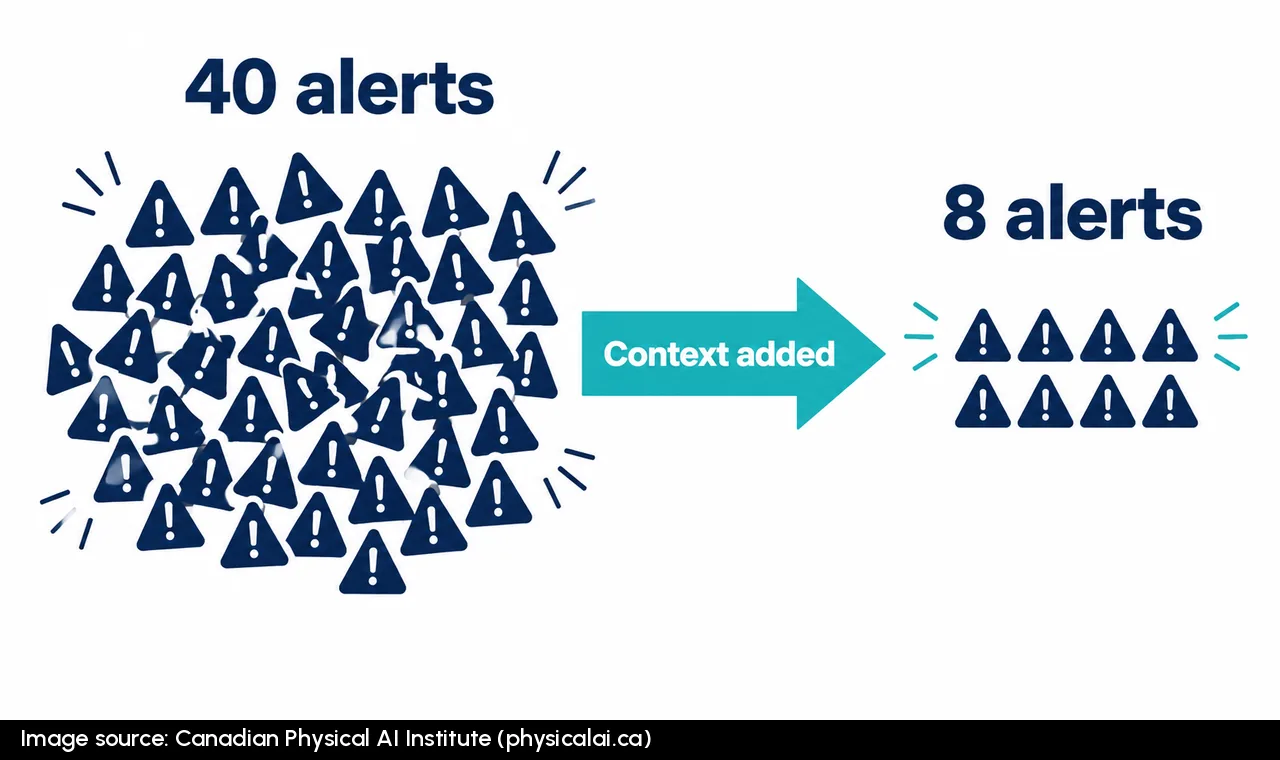
Assume the Ontario plant evaluates its anomaly detector over 20 operating shifts. Leah compares the initial configuration with a revised version that uses better recipe and operating-mode context.
The table shows the resulting notification count, confirmed findings and review time.
| Illustrative measure | Initial configuration | Revised configuration |
|---|---|---|
| Operating shifts evaluated | 20 | 20 |
| Total alerts | 40 | 8 |
| Confirmed useful findings | 4 | 3 |
| Nonactionable alerts | 36 | 5 |
| Nonactionable alerts per shift | 1.8 | 0.25 |
| Review time per nonactionable alert | 10 minutes | 10 minutes |
| Total nonactionable review time | 6 hours | 50 minutes |
The revised configuration substantially reduces unnecessary investigation time, but it also produces one fewer confirmed finding. Leah cannot declare the revision successful without checking which event was missed and whether that omission was acceptable.
Now suppose one confirmed pump alert occurs three hours before the existing high-current alarm would have activated. That is three hours of potential early warning, not three hours of automatically avoided downtime.
The maintenance team still needs to verify the condition, determine an appropriate response and arrange an intervention before the production consequence. A second alert that arrives only moments before a shutdown may be technically correct but operationally too late.
Leah therefore records both warning time and feasible response time. A model that finds problems early but cannot support an intervention may have limited economic value. One that provides more useful warning time with fewer unnecessary interruptions is a stronger candidate.
The business case must turn that distinction into a defensible cost calculation.
Calculate Business Value Without Counting Every Anomaly as Savings
For management, Leah separates technical performance from financial value. An AI detection is not the same as a prevented failure, and a prevented failure is not automatically equivalent to the full value of scheduled production.
The calculation should identify the loss that would actually have occurred without the earlier intervention.
A practical business-case equation is:
Net incremental value = verified additional losses avoided – inspection and intervention costs – monitoring and integration costs – ongoing model and support costs.
Pilot costs depend on sensor and tag readiness, edge hardware, integration effort and the validation period. Ask suppliers to separate one-time hardware and integration costs from recurring software, support and model-governance costs before comparing proposals.
Avoided losses may include unrecoverable production, product waste, additional CIP, emergency repair expense or other documented consequences. Production that can be recovered later should not automatically be valued as permanently lost output.
The site’s manufacturing downtime cost guide provides a framework for distinguishing constrained production from situations where spare capacity changes the financial consequence.
Leah should also include the cost of investigating false alerts. A warning that requires unnecessary inspections consumes technician time, even if the plant never experiences a production stop.
For Canadian context, NGen’s food-processing project announcement describes a CAD $3 million collaboration involving advanced analytics, productivity and energy monitoring.
That establishes activity in Canadian manufacturing analytics, but it does not provide independently verified ROI or false-alert results for the type of anomaly detector Leah is evaluating. Her management proposal should present demonstrated local findings separately from projected annual savings.
With the financial boundary established, several common technical questions remain.
Frequently Asked Questions About AI Anomaly Detection in Manufacturing
Plant teams evaluating anomaly detection often use similar terminology for different technical and operational problems. These answers clarify the distinctions relevant to Leah’s proposed monitoring system.
What are the three types of anomaly detection?
Three commonly described anomaly categories are point, contextual and collective anomalies.
A point anomaly is an individual observation that differs substantially from typical values.
A contextual anomaly is unusual only under particular conditions, such as an otherwise acceptable pump current occurring at an unexpected line speed.
A collective anomaly is a pattern or sequence that is unusual even though its individual measurements may look acceptable.
Is anomaly detection unsupervised?
Not necessarily.
Unsupervised methods identify unusual patterns without requiring every observation to have a fault label.
Normal-only or semi-supervised methods learn from data believed to represent healthy operation.
Supervised methods use labelled examples of known faults or outcomes.
What are some common anomaly detection techniques?
Common approaches include statistical baselines, PCA, Isolation Forest, One-Class SVM, autoencoders and time-series forecasting.
They differ in their data requirements, sensitivity to operating context and ability to explain a detection. The appropriate technique depends on the available signals, process behaviour and required explanation, rather than algorithmic sophistication alone.
What is the difference between anomaly detection and outlier detection?
Outlier detection commonly identifies individual observations that are unusually different from other observations. Anomaly detection is a broader concept that can also examine operating context and sequences over time.
For example, one unusually high motor-current reading might be an outlier, while a sequence of unusual measurements could indicate a process deviation that requires further investigation.
Can you give me an example of anomaly detection?
Leah’s hypothetical pump provides one. A detector identifies a departure from the pump’s historically healthy behaviour and creates a maintenance advisory.
The advisory prompts verification. It does not automatically establish the root cause or require the pump to stop.
What is the difference between a false alarm and a nuisance alarm?
A false alarm indicates a condition that is not actually present.
A nuisance alarm creates an unnecessary interruption or provides little useful operational action, even if the measurement that triggered it is technically correct. A repeated alarm that toggles around its limit can also become a nuisance.
Leah should measure whether alerts lead to appropriate action, not simply whether a mathematical deviation occurred.
What is alarm management?
Alarm management is the systematic process of identifying, designing, operating, reviewing and improving alarms so operators receive meaningful information requiring appropriate action.
ISA-18.2 and IEC 62682 provide relevant lifecycle frameworks.
What are some examples of food safety monitoring methods?
Food plants use established process measurements, inspections, records and verified control procedures to support food-safety monitoring. Depending on the process, these can include temperature monitoring, metal detection, sanitation verification and quality checks.
AI anomaly detection can provide additional information about unexpected process behaviour, but it should not independently replace validated food-safety controls or established QA release decisions.
An anomaly may justify investigation, but it does not by itself establish whether a product is safe or unsafe.
The Practical First Step: Prove One Useful Warning
Leah’s next decision is whether the pump pilot demonstrates useful warning time, a manageable false-alert workload and credible incremental value.
If the evidence supports expansion, she can move to another asset with documented failures and a clear response owner. If the model cannot improve on existing monitoring without creating unnecessary work, she should revise or stop the pilot rather than proceed with a plant-wide rollout.