At a plant processing about 1.2 million cattle a year, even 0.1 lb of extra meat recovered per animal is worth hundreds of thousands of dollars. Two beef operations hunt for it with AI vision meat yield systems, placing the cameras in different spots.
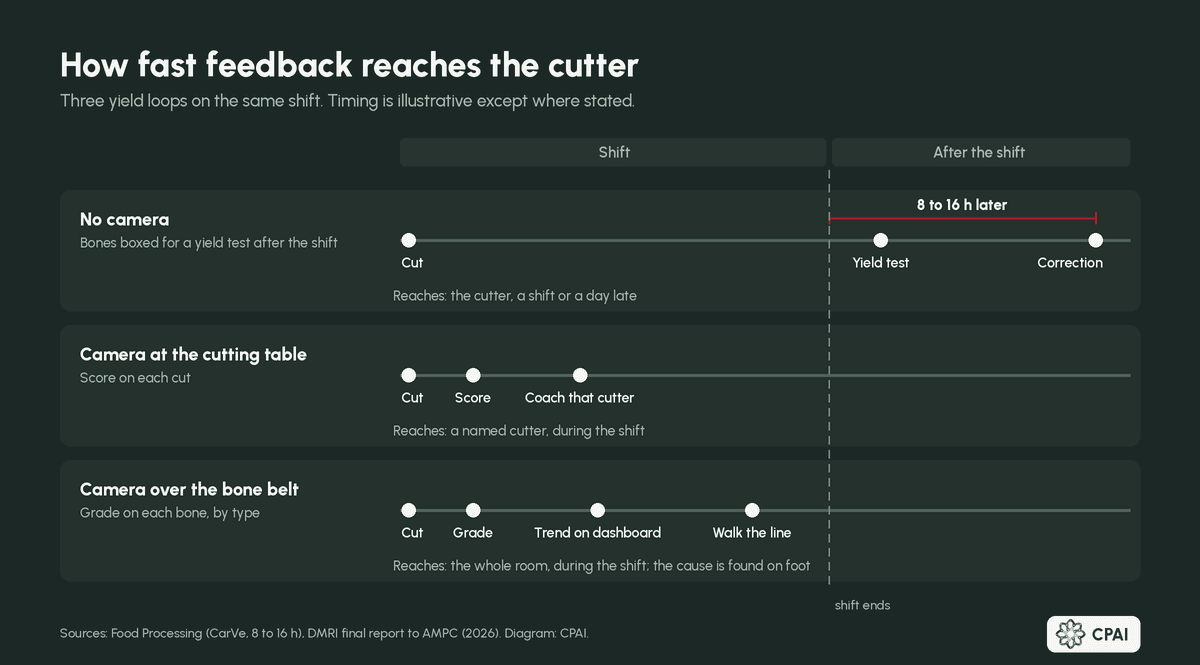
Cargill uses CarVe, an in-house computer vision system at the chuck tables. Cameras catch specks of meat left on bone and give supervisors a score they can act on during the shift. Before, bones were boxed for a yield check after the shift, and corrections reached the cutter 8 to 16 hours later. CarVe runs at chuck tables in High River, Alberta, with Guelph, Ontario, next, and at three US plants: Friona, Texas; Fort Morgan, Colorado; and Dodge City, Kansas (Food Processing).
A Danish beef processor has run a different setup since early 2025. Researchers from DMRI, funded by Australia’s AMPC, put one RGB camera in a washdown steel cabinet above the bone belt, where bones from the forequarter and hindquarter lines leave the room. It grades what is left on the bones. Their estimate for most processors is 100 to 500 g more meat per carcass, with payback in 6 to 36 months on a system priced at AUD 150,000 to 200,000 (AMPC 2026 report).
Cargill’s own math puts that 0.1 lb at roughly $778,000 a year, using a chuck roll price of about $6.49/lb. Its target is higher, about 0.25 lb per carcass, mostly around the neck bones, which it values at about $2 million at a single site (Drovers). That 0.25 lb (about 113 g) sits at the low end of DMRI’s range. Cargill also reports a 0.5% average yield gain, but coverage doesn’t give the base, so test the per-head figures against your own yield data (Food Processing).
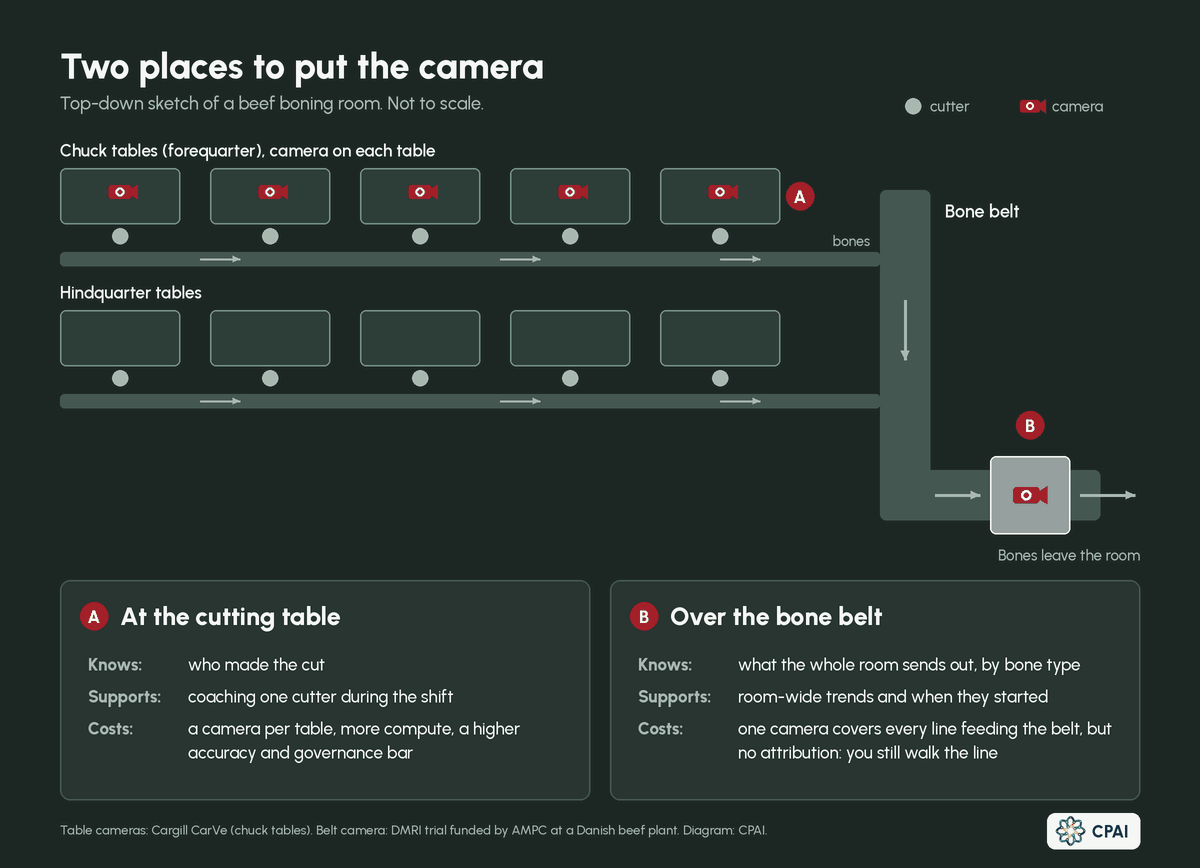
In AI vision meat yield work, camera placement decides what kind of decision the system can support, in beef or any line where a skilled hand sets yield. A table camera supports coaching a named person while the shift is running. A bone-belt camera supports watching the whole room’s trend at lower cost.
At the cutting table: faster coaching, heavier burden
The table camera buys attribution and speed. It also raises the accuracy bar and the governance load.
A camera at the table knows who made the cut, so a supervisor can coach one cutter on pacing, knife work or a safety habit instead of talking to the whole line. Cargill says cutters got more engaged once they saw their own scores and began asking for feedback (Drovers).
The first bar is accuracy. In DMRI’s earlier lab work, combining RGB, near-infrared and dual-energy X-ray graded about 70% of individual loin bones exactly right, against 55 to 60% for either sensor alone, with most misses one grade off. The same report judged a single sensor good enough for tracking trim quality over time (AMPC 2022, Stage 2). These accuracy figures do not describe CarVe, a proprietary system whose accuracy Cargill has not published. They show why per-piece coaching demands a much higher validation bar than aggregate trend monitoring. Per-piece accuracy by grade, at your line speed, on your product, is the number to ask any supplier for.
The second bar is governance. Cargill briefed union leadership on what CarVe is and is not, and committed that it is a coaching tool, not a disciplinary one (Colorado Sun). Research on electronic monitoring is a caution for any plant doing this: a meta-analysis of 94 samples (23,461 workers) found no average performance gain and higher stress, while more transparent, less invasive monitoring went with better attitudes (Ravid et al., Personnel Psychology 2023). In practice, transparency means telling workers what is stored, for how long, and who can see it.
Cost also grows table by table. More tables mean more cameras and more compute, and Cargill says rollout has run ahead of its server capacity (Food Processing).
 Reader offer · ends November 11Where is the hidden cost in your factory?Watch it with 3 months of Premier free →
At the bone belt: cheaper trends, weaker attribution
One camera watches what the whole room sends out. It costs less and covers every line feeding the belt, but it sees trends, not people.
The Danish unit is modest: an area-scan camera, an LED panel and a mini-PC inside the cabinet. It keeps up with the belt at full production speed, sorts bones into 21 types and grades five high-value types from 1 (great trim) to 4 (too much meat left). The team chose plain RGB over multispectral to keep cost down (AMPC 2026).
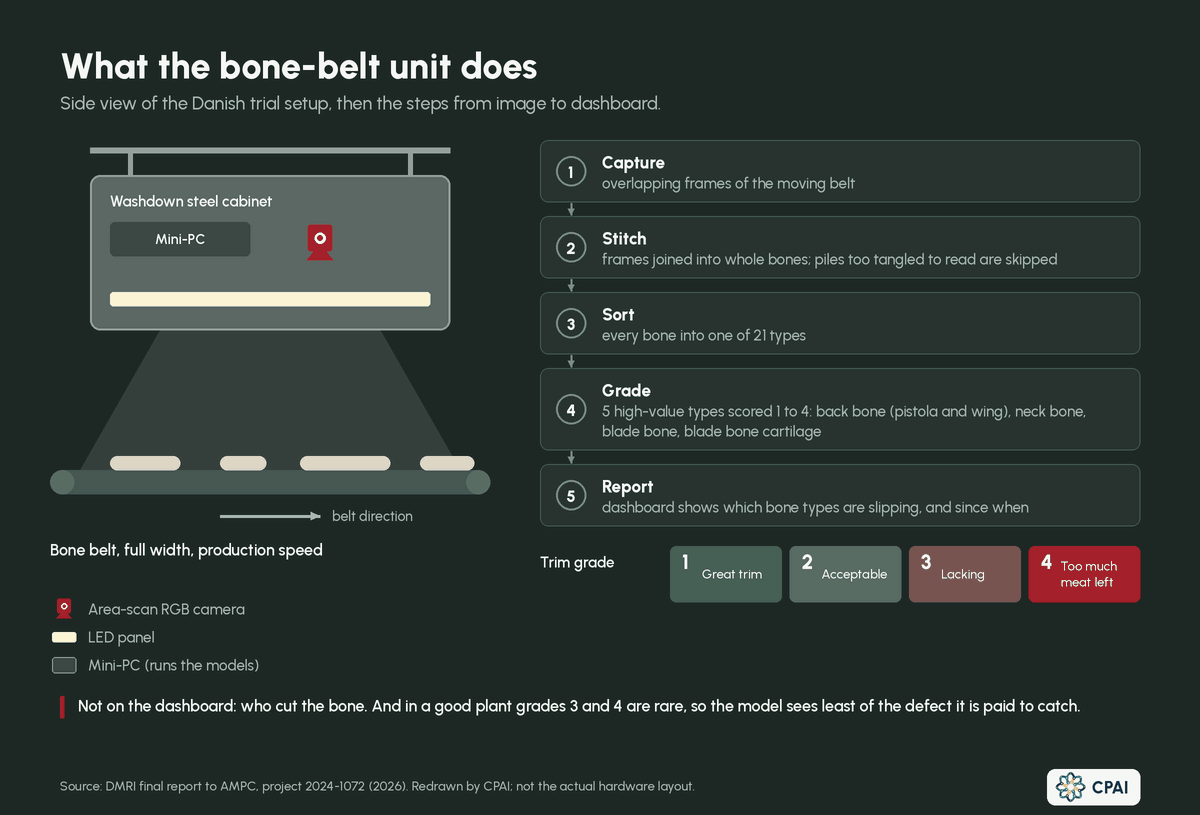
It does not know who cut the bone; linking bones to carcass batches through the MES is future work. The dashboard shows which bone types are slipping and since when. Finding the cause still means walking the line.
The less obvious cost comes from a good plant’s own data. Over 15 workdays in Q2 2026, grade 3 and 4 bones were rare, and in one training period no grade 4 back bone showed up at all. The model learns least about the defect the plant is paying it to catch. Grade 2 was the one most often confused with 1 or 3. The fix is slow: an experienced butcher keeps reviewing images and adding the rare cases, so that butcher’s hours belong in the budget next to the camera.
In poultry, downstream vision that estimates rest meat on each carcass after fillet harvesting is already sold commercially. The beef bone-belt unit is still a research prototype, and CarVe is Cargill’s in-house system.
Choosing a position for AI vision meat yield cameras
If you do not yet know which bone types or shifts lose the most, the cheaper downstream view can show which tables would justify cameras. If losses already point to specific stations, and turnover keeps refilling them with new cutters, coaching at the cutting table goes straight at the cause. Cargill frames CarVe partly as a training tool for exactly that turnover (Food Processing).
Two deployment realities apply either way. DMRI ties its payback range to a condition that holds for both positions: the data has to drive corrective action on the floor or send high-potential bones back for retrimming. And the camera lives in a cold, wet room, where a window below the dew point fogs; a small window heater beats cleaning up hazy images in software.
What nobody has measured yet
Motor-learning research adds a wrinkle to the training case. In Winstein and Schmidt’s experiments, giving learners their results less often during practice led to equal or better retention than feedback after every attempt (Winstein & Schmidt 1990). That was a lab task, not a boning knife on a moving chain.
No one has published what happens when a cutter trained with a score on every piece moves to a table without a camera. A plant piloting table cameras could find out with a few weeks where scores are still recorded but hidden from cutters. That result would show whether the camera taught a skill or became part of it.