A shelf-life model flags a high-risk pallet after a temperature exposure event.
Shipping wants to know whether it can still go out. QA wants the evidence behind the score. Operations wants to avoid holding good product. The supervisor asks who has authority to stop the shipment.
Nobody has a clear answer.
That is where AI projects get risky in food and beverage plants. Not because the model is useless. Because the plant has not decided what happens after the alert.
This guide is for Canadian Food & Beverage plant leaders evaluating AI, automation, machine vision, robotics, or connected data systems. It will help you decide whether a use case is ready for a pilot, what must be fixed first, and how to avoid installing another system that creates noise instead of action.
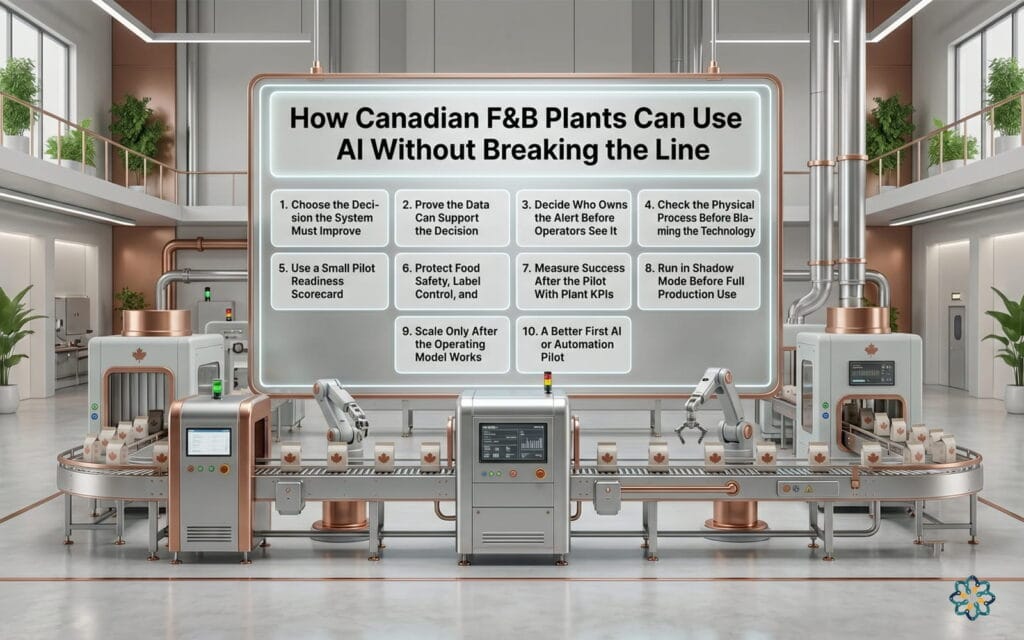
In this guide, you’ll learn how to:
- Decide which AI or automation use case is safe to pilot first
- Check whether your plant data can support the decision you want to improve
- Assign ownership before alerts reach operators, QA, maintenance, or supervisors
- Avoid pilots that create audit risk, false alarms, or disconnected dashboards
- Measure success with plant KPIs, not vendor claims
- Build a small operating model before scaling across lines or sites
Choose the Decision the System Must Improve
A strong pilot is built around one plant decision.
Not a platform. Not a dashboard. Not a general promise to “use AI.”
The decision should be specific enough that a supervisor, QA lead, engineer, or maintenance tech knows what action may change.
Examples:
| Plant decision | Better pilot question | Business outcome |
|---|---|---|
| Hold or release a finished lot | Can we flag shelf-life risk before shipment? | Fewer write-offs and complaints |
| Adjust a batch before it drifts | Can we detect process drift earlier than lab results? | Less rework and better yield |
| Reject a package defect | Can we detect and remove the right unit every time? | Fewer escapes and less false reject waste |
| Escalate a maintenance issue | Can we identify a developing failure before downtime? | Lower unplanned downtime |
| Clear a changeover | Can we confirm the line is truly back to good product at full rate? | Less startup scrap |
The decision matters because AI and automation only create value when someone can act on the output.
A model that predicts risk but does not change a release decision is just another report. A vision system that detects defects but rejects the wrong pouch is not a quality improvement. It is an integration problem.
Ask your team:
What decision are we making too late, with too little evidence, or with too much manual judgment?
That answer should shape the pilot.
A dairy plant wants to use AI to reduce shelf-life complaints.
The weak pilot is a dashboard showing “risk scores” for all finished goods.
The stronger pilot focuses on one product family, one cooler zone, and one shipping decision: which pallets need QA review before long-distance shipment.
That narrow scope gives QA, shipping, and operations a real decision to test.
Prove the Data Can Support the Decision
Most plants already collect useful data. The issue is whether the data is connected, trusted, and specific enough to support action.
A shelf-life model may need receiving temperature, cooler dwell time, door-open events, product age, trailer condition, route history, and complaint data.
A batch-drift model may need ingredient lot, formula version, process temperature, mixer speed, hold time, viscosity checks, operator adjustments, and QA release results.
A predictive maintenance model may need fault history, downtime codes, work orders, sensor readings, and maintenance notes.
If those records live in different systems with different product names, timestamps, or lot formats, the model will struggle.
That is not an AI problem. It is a data ownership problem.
Before buying or piloting anything, check these items:
| Readiness check | Why it matters |
|---|---|
| Product names match across ERP, WMS, MES, QA, and line records | Prevents bad joins and misleading reports |
| Lot codes connect raw materials to finished goods | Supports recall scope and root-cause work |
| Downtime codes are specific enough to guide action | Prevents weak maintenance predictions |
| QA holds, releases, and dispositions are timestamped | Shows when decisions happened |
| Recipe versions are controlled | Prevents comparing unlike batches |
| Rework, repack, relabel, and returns are traceable | Protects genealogy and audit readiness |
| Sensor calibration status is visible | Prevents trusting bad signals |
A useful pilot may expose gaps. That is acceptable.
What you want to avoid is paying for a model before you know which records it needs and who owns them.
Do not treat data cleanup as an IT task only.
QA owns some of the meaning. Operations owns some of the reality. Maintenance owns sensor health. Engineering owns integration. IT owns infrastructure and access.
If one group cleans the data without the others, the plant may end up with tidy records that do not reflect how production actually runs.
Decide Who Owns the Alert Before Operators See It
An alert without an owner becomes background noise.
That is especially risky in food plants because alerts can affect product release, sanitation, allergen changeovers, maintenance response, or shipment timing.
Before a pilot goes live, define the response path.
Use this simple alert ownership checklist:
| Question | Required answer before pilot |
|---|---|
| What does the alert mean? | A plain-language definition |
| Who receives it first? | Role, not just a name |
| What should they check? | First verification step |
| What action is allowed? | Hold, inspect, adjust, escalate, or monitor |
| What action is blocked? | Anything the system cannot authorize |
| Who can override it? | Named role with recordkeeping |
| What evidence is stored? | Images, records, values, timestamps, or notes |
| Who reviews false alarms? | Owner for continuous improvement |
This is where many pilots fail after a promising demo.
The system may detect something real, but the response plan is vague. Operators stop trusting it. QA asks for proof. Maintenance questions the sensor. Supervisors ignore the alerts because they create more work than clarity.
The fix is not more alerts.
The fix is a runbook.
For each AI or automation alert, document the trigger, evidence, first check, allowed action, escalation owner, override rule, and recordkeeping requirement.
A bakery installs machine vision to detect missing bilingual labels on multipacks.
The camera performs well during testing. Problems appear during seasonal artwork changes.
Operators are unsure whether to stop the line, reject only the affected packs, or call QA. Maintenance adjusts lighting to reduce false rejects, but QA was not part of the change.
The issue is not only the camera.
The plant needed a label-defect runbook covering artwork versions, reject confirmation, QA review, operator escalation, and maintenance change control.
Check the Physical Process Before Blaming the Technology
AI and automation often reveal problems that were already there.
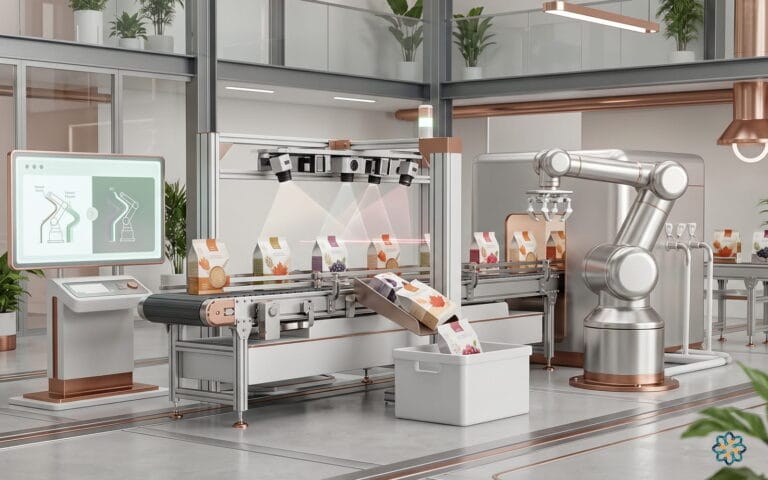
A vision system may expose inconsistent product presentation. A robot may expose poor upstream accumulation. A batch model may expose uncontrolled operator adjustments. Predictive maintenance may expose weak downtime codes.
That discovery is useful, but only if the plant acts on it.
Before blaming the technology, check the physical and process constraints around the use case.
For machine vision, review:
- Lighting stability across shifts
- Glare from film, moisture, or packaging
- Product position at the inspection point
- Reject timing and reject confirmation
- Image storage for QA review
- Cleaning access and washdown protection
- Seasonal, bilingual, and private-label artwork changes
For robotics, review:
- SKU mix and case format variation
- Product fragility and temperature
- Gripper cleanability
- Tool-change needs
- Guarding and traffic flow
- Upstream and downstream accumulation
- Operator recovery after a fault
- Maintenance access to wear parts
For process AI, review:
- Whether operators follow the same adjustment logic
- Whether recipe versions are controlled
- Whether lab results arrive too late for correction
- Whether sensors survive washdown, foam, steam, and product buildup
- Whether the model can distinguish normal startup from true drift
The device is rarely the whole project.
The surrounding process decides whether the device creates value.
Do not install technology around the PLC, QA system, or maintenance workflow.
A standalone system may look fast to deploy, but it usually creates extra screens, extra manual checks, and unclear ownership.
Plant-ready automation needs integration with line states, faults, recipes, reject confirmation, QA hold logic, maintenance diagnostics, and cybersecurity requirements.
Use a Small Pilot Readiness Scorecard
A good first pilot should be narrow enough to manage and painful enough to matter.
Use this scorecard before approving the project.
| Readiness area | Green signal | Red signal |
|---|---|---|
| Decision clarity | One decision is clearly defined | The project is a broad dashboard |
| Data access | Required records are reachable | Key data lives in paper notes or disconnected files |
| Action path | The response owner is known | Alerts have no runbook |
| Risk level | The pilot advises or screens first | The pilot changes setpoints or release status too early |
| KPI value | One business metric can prove value | Success is defined as “AI adoption” |
| Team ownership | QA, operations, maintenance, engineering, and IT are aligned | One department is carrying the project alone |
| Maintainability | The plant can support the system after launch | Every fault requires vendor help |
A strong first pilot usually has these traits:
- One line
- One product family
- One painful KPI
- One accountable owner
- Clear evidence requirements
- A response plan that fits shift reality
- A low-risk operating mode before full rollout
A weak first pilot tries to cover every product, every line, and every decision at once.
Practical rule of thumb
If the pilot cannot explain what a supervisor should do differently on shift, it is not ready for production.
Protect Food Safety, Label Control, and CFIA Readiness
Automation projects in food plants have a different risk profile than many other manufacturing environments.
The plant is not only trying to improve throughput. It also has to protect product safety, label accuracy, allergen controls, sanitation access, traceability, and audit retrieval.
That changes the design.
For any AI or automation pilot, confirm how it affects:
- HACCP or preventive control records
- QA hold and release decisions
- Allergen changeover verification
- Sanitation access and pre-op checks
- Bilingual label and artwork control
- Lot genealogy and recall exercises
- Rework, repack, relabel, and return flows
- Customer and CFIA audit evidence
The important question is not whether the system stores more data.
The question is whether the right person can retrieve the right evidence quickly, explain the decision, and show what happened to the affected product.
A sauce manufacturer wants to use AI to monitor sodium variation after a reformulation.
The model may help identify risk from supplier variation, moisture loss, batch yield, and rework. But the plant still needs QA and regulatory control over claims, Nutrition Facts values, formula versions, and artwork approval.
AI can flag label risk.
It should not approve the claim.
That approval still belongs to the qualified owner.
Do not let a low-risk assistant quietly become a high-risk decision-maker.
An AI tool that retrieves an SOP is one risk level. A model that recommends a batch adjustment is another. A system that changes setpoints or affects product release is much higher risk.
Treat each level differently.
Measure Success After the Pilot With Plant KPIs
A pilot should prove operational value, not technical novelty.
Define success before the vendor demo. Otherwise, the project may drift toward whatever the software can show instead of what the plant needs to improve.
Use KPIs that connect to the original decision.
| Use case | Better success measure |
|---|---|
| Shelf-life risk model | Waste by reason code, complaint rate, QA hold accuracy |
| Golden batch analytics | First-pass quality, rework rate, yield, operator interventions |
| Machine vision | Defect escape rate, false reject rate, confirmed reject accuracy |
| Robotic palletizing | Labour hours per pallet, cases per minute, fault recovery time |
| Changeover analytics | Last-good to first-good time, startup scrap, first-hour micro-stops |
| Predictive maintenance | Downtime minutes, MTBF, planned versus unplanned work |
| AI SOP assistant | Correct source retrieval, escalation accuracy, reduced search time |
Measure false alarms as carefully as wins.
A model that catches one real issue but creates constant noise will lose trust. A vision system that reduces escapes but rejects too much good product may simply move cost from complaints to scrap.
Review the pilot with the people who live with the system:
- Operators
- Shift supervisors
- QA technicians
- Maintenance technicians
- Engineering
- Sanitation
- IT or OT support
- Plant leadership
Ask two diagnostic questions during review:
Did the system help us make the target decision earlier or with better evidence?
Did it create extra work, confusion, or risk anywhere else in the process?
If the answer to the second question is yes, fix the operating model before scaling.
Run in Shadow Mode Before Full Production Use
Trust should be earned before the system affects production decisions.
Shadow mode is often the safest first step.
The system watches the process and produces recommendations, but the team does not act on them yet. Instead, the plant compares the system’s output against real decisions and known outcomes.
Review questions should include:
- Would the model have flagged the bad batch earlier?
- Would it have held good product unnecessarily?
- Would it have caught the label issue before QA?
- Would it have matched the senior operator’s judgment?
- Would it have created noise during startup?
- Would maintenance have trusted the sensor behind the alert?
- Would the evidence have helped during an audit or customer investigation?
Shadow mode is not wasted time. It shows whether the system understands plant reality before people depend on it.
It also helps operators and supervisors challenge the tool before they are expected to trust it.
Scale Only After the Operating Model Works
Scaling is not copying the same software to another line.
Line 2 may have a different layout, different sanitation access, different operators, different packaging formats, different traffic flow, and different maintenance habits.
Before scaling, document what actually made the pilot work.
Capture:
- The decision improved
- The KPI movement
- The required data sources
- The PLC tags or system connections used
- The QA evidence required
- The operator actions added
- The maintenance tasks added
- The sanitation constraints found
- The false alarms reviewed
- The training gaps fixed
- The support model after launch
Separate what must stay standard from what can adapt locally.
| Keep standard | Allow local fit |
|---|---|
| Data naming rules | HMI screen layout |
| Alert severity definitions | Escalation contacts |
| QA evidence requirements | Product-specific thresholds |
| Cybersecurity requirements | Mounting and guarding details |
| Maintenance PM structure | Access and cleaning details |
| Training framework | Shift-specific examples |
Too much standardization ignores plant reality.
Too much customization makes the system hard to support.
The right balance lets the plant scale without turning every line into a custom project.
A Better First AI or Automation Pilot
The safest first pilot is not the flashiest one.
It is the one tied to a real plant decision, supported by usable data, owned by the right team, and measured against a business outcome.
For many Canadian F&B plants, that may be:
- A shelf-life risk model for one product family
- A machine vision system for one recurring label or seal defect
- Golden batch analytics for one high-rework process
- Changeover analytics for one unstable SKU family
- Predictive maintenance on one chronic failure mode
- An AI assistant that retrieves approved SOPs, manuals, or QA records
The technology matters.
But the plant decision matters more.
Before you buy the software, camera, robot, or model, decide what action it will support, who owns that action, what evidence they need, and how success will be measured.
That is how AI and automation become useful on the floor.
Not by adding another dashboard.
By helping the plant act earlier, with better evidence, less confusion, and clearer accountability.